
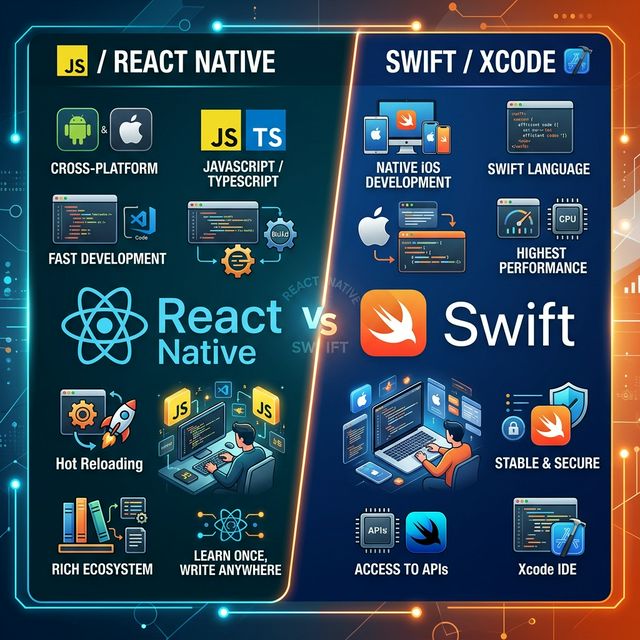
The mobile app development landscape in 2026 is defined by a primary question: should you build "cross-platform" or "native"? While the gap between the two has narrowed significantly, the choice between React Native and Swift remains a fundamental decision that affects your budget, performance, and future scalability.
React Native offers the promise of "Write Once, Run Anywhere," allowing businesses to maintain a single codebase for both iOS and Android. Conversely, Swift is Apple's powerhouse language designed to squeeze every bit of performance out of iOS hardware. In this guide, we'll break down the pros, cons, and global adoption patterns of both to help you choose the right path for your business.
Created by Meta (formerly Facebook), React Native has matured into a robust framework that powers millions of apps, including Instagram, Shopify, and Skype. Its core appeal in 2026 lies in its efficiency.
Swift is Apple's native language for iOS, macOS, watchOS, and tvOS. It is built for speed, safety, and deep integration with Apple's entire hardware ecosystem. For premium experiences, Swift remains unbeatable.
Choosing between the two involves balancing technical requirements with business reality.
| Feature | React Native | Native Swift |
|---|---|---|
| Development Speed | Very Fast (Single Codebase) | Slower (Two separate teams needed) |
| Performance | Excellent for most business apps | Superior (Raw hardware access) |
| Cost | Lower (approx. 40% savings) | Higher (Dual platform costs) |
| User Interface | Very Close to Native | Perfectly Native Feel |
| Maintenance | Easier (shared logic) | Complex (two separate apps) |
| Best For | Startups, MVPs, E-commerce, SaaS | Games, AR/VR, Hardware-intensive apps |
Mobile development preferences often align with how businesses in these regions prioritize speed vs. brand perfection.
The US startup scene in Silicon Valley heavily favors React Native for speed, while giant corporations like Apple and Uber use Swift for their core consumer-facing experiences.
India is the global hub for React Native talent. Thousands of agencies in India specialize in building high-quality, cost-effective cross-platform apps for global clients.
Chinese "Super Apps" often use a hybrid approach, but Swift remains popular for high-end luxury e-commerce platforms targeting affluent iPhone users in urban centers.
The UK's FinTech sector prefers Swift for its security and performance, though React Native is widely used for prototype testing and small business solutions.
In 2026, there is no single "correct" answer.
Yes, for most enterprise and e-commerce apps. However, for graphic-intensive apps or those needing deep system integration, native Swift is still superior.
Typically, Swift is more expensive because you need to build the Android version separately. React Native allows for maintaining a single codebase for both platforms.

Whether you need a high-performance Swift-native app or a cost-effective React Native solution, Scenic IT Solutions has the expert mobile development team to make it happen. We build apps that aren't just functional — they're built to scale and dominate the market.
Need an expert mobile partner? Hire our mobile team or get a free quote for your project today.