
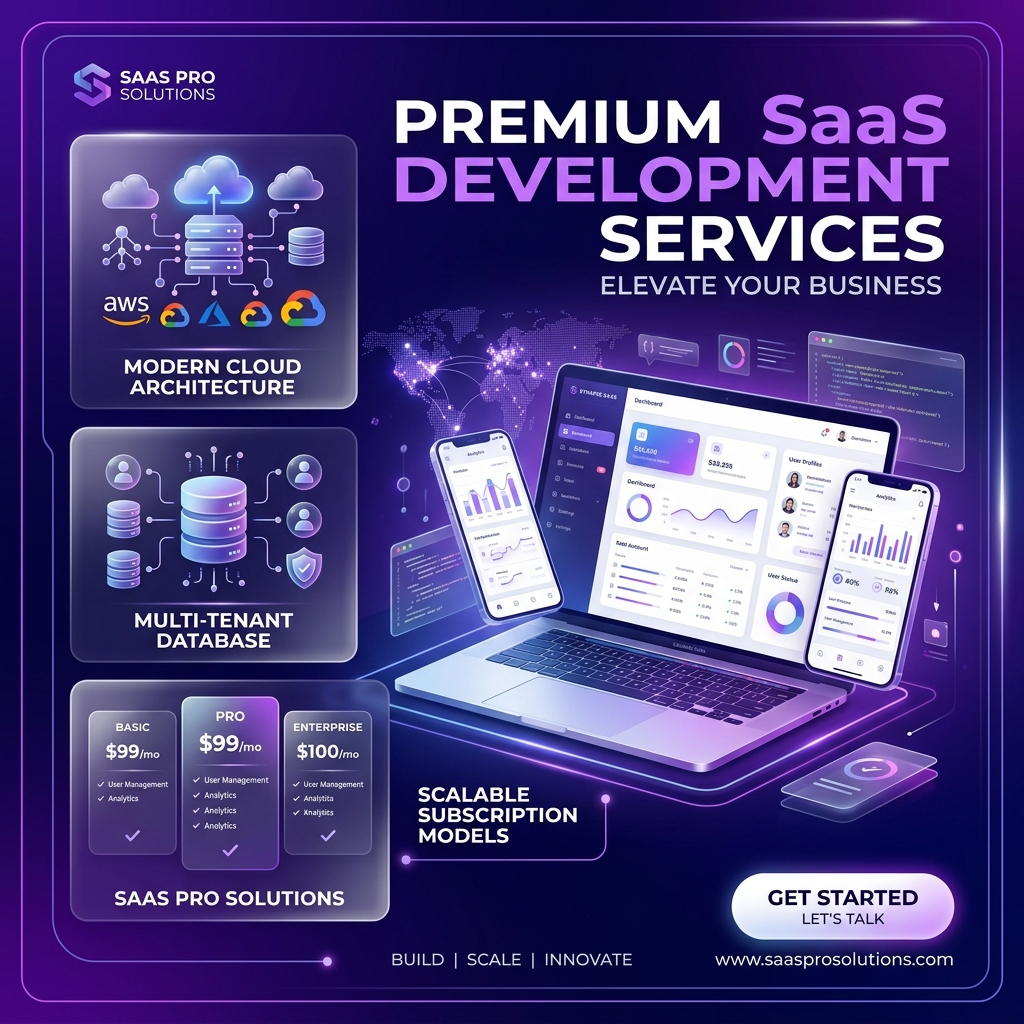
Software as a Service (SaaS) has completely dominated the technology sector. In 2026, building a SaaS product isn't just about writing code; it's about architecting a highly scalable, multi-tenant environment that can support thousands of concurrent users while maintaining peak performance and absolute data security.
Whether you are launching a new startup or transitioning a legacy desktop application to the cloud, understanding modern SaaS development methodologies is the key to unlocking recurring revenue and global scalability.
The defining feature of any true SaaS application is its architecture. In a multi-tenant architecture, all customers (tenants) share the same underlying infrastructure and codebase, but their data is securely isolated.
In 2026, the stack you choose determines how fast you can iterate. The MERN stack (MongoDB, Express, React, Node.js) remains highly popular for its JavaScript uniformity. However, for robust backend processing, frameworks like Laravel (PHP), Django (Python), and Spring Boot (Java) are favored for their stability.
On the frontend, single-page application (SPA) frameworks like React and Vue.js provide the fast, responsive, "desktop-like" experience that modern SaaS users demand.
A SaaS is only as good as its billing engine. Integrating robust payment gateways like Stripe or Paddle is crucial. Your architecture must smoothly handle:
When you hold data for multiple companies, security is your primary product. Your SaaS must enforce strict Role-Based Access Control (RBAC), utilize HTTPS everywhere, and encrypt sensitive data at rest. Depending on your target market, you must architect your system to comply with GDPR, CCPA, or HIPAA from day one.
Building a SaaS is a marathon, not a sprint. The technical foundation you lay during development will determine your ability to scale from ten users to ten million. Partnering with an experienced SaaS development agency ensures that your architecture is robust, secure, and ready for global growth.
A multi-tenant microservices architecture is best, as it allows you to serve multiple clients from a single codebase while independently scaling individual features.
The cost varies widely, but a robust MVP typically ranges from $20,000 to $50,000, while complex enterprise platforms can exceed $150,000.
Turning a great idea into a profitable SaaS product requires technical excellence. At Scenic IT Solutions, we build high-performance, scalable cloud software designed for rapid growth and secure multi-tenant operations.
Looking for a technical partner? Hire our specialized SaaS developers or get a free architecture consultation today.