
React vs Vue.js in 2026: The Ultimate Comparison for Businesses & Developers
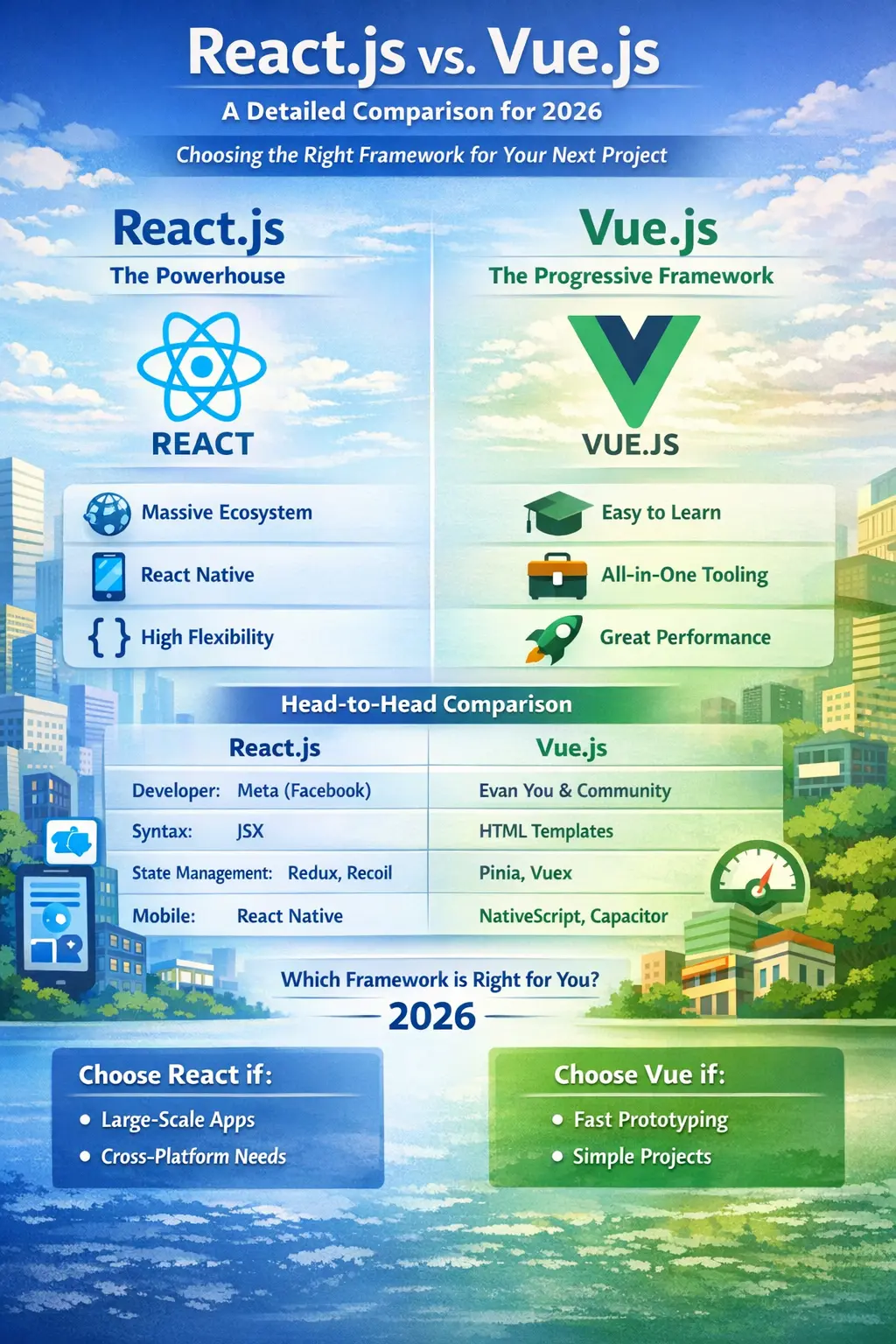
When architecting modern web applications, the choice between React and Vue.js is one of the most common and pivotal technology decisions businesses face. Both power millions of websites and enjoy passionate global communities.
Direct Answer: Choose React if your project requires maximum flexibility, a massive developer hiring pool, and seamless mobile cross-compilation with React Native; choose Vue.js if you prioritize rapid developer onboarding, clean HTML template separation, and exceptional built-in reactivity with zero configuration headaches.
At Scenic IT Solutions, we build high-concurrency client portals and enterprise dashboards across both frameworks. Here is our direct 2026 comparison.
⚡ Key Takeaways
- React is backed by Meta and features a massive global ecosystem, making it the undisputed standard for enterprise hiring and venture-backed tech startups.
- Vue.js is an independent, community-driven progressive framework celebrated for intuitive single-file components (.vue) and effortless developer ergonomics.
- React uses JSX (JavaScript XML) treating UI as pure JavaScript logic; Vue uses HTML-based templates that separate layout, style, and behavior cleanly.
- Vue 3's Composition API and Pinia state management mirror the power of React hooks while offering superior reactivity performance out of the box.
- Both frameworks achieve outstanding Core Web Vitals when paired with server-side rendering meta-frameworks (Next.js for React, Nuxt for Vue).
1. Core Philosophy: The Meta-Backed Powerhouse vs. The Community Champion
The Direct Answer: React embodies the "Everything is JavaScript" philosophy created by Meta, treating HTML as JavaScript expressions, whereas Vue is a progressive, community-driven framework created by Evan You that respects traditional web development separation of concerns.
React is intentionally minimalist: it only provides the view layer. You must select external libraries for routing, state management, and animations. Vue is more cohesive, providing officially maintained solutions for routing (Vue Router) and state (Pinia).
2. Syntax and Structure: JSX vs. Single-File Components (.vue)
The Direct Answer: React uses JSX, allowing developers to write HTML tags directly within JavaScript functions; Vue uses Single-File Components (.vue) containing distinct <template>, <script>, and <style> blocks.
JSX provides immense programmatic power: you can manipulate UI elements using standard JavaScript map, filter, and ternary operators. Vue's template syntax is more readable for designers and junior developers who prefer standard HTML markup.
3. State Management and Ecosystem: Redux/Zustand vs. Pinia
The Direct Answer: React relies on third-party state managers like Zustand, Redux Toolkit, or Jotai; Vue 3 provides Pinia, an officially supported state management library that provides type-safe, modular global stores with zero boilerplate.
Vue's native proxy-based reactivity system tracks dependencies automatically, eliminating the complex dependency arrays (useEffect([deps])) that frequently cause subtle infinite-loop bugs in React applications.
4. Performance Benchmarks: Rendering Speed, Bundle Sizes & Hydration
The Direct Answer: Both frameworks execute DOM updates in single-digit milliseconds. Vue 3's compiler optimizes static HTML blocks at compile time, giving it slightly smaller bundle sizes and faster re-rendering on complex component trees.
However, in production applications, runtime speed differences between React and Vue are negligible. Server response times, image optimization, and database query latency have a vastly greater impact on user experience than client-side framework benchmarks.
5. Head-to-Head Comparison Matrix: React vs. Vue.js (Detailed Table)
The Direct Answer: This comparison matrix details the foundational differences between React and Vue.js in 2026.
| Feature | React.js | Vue.js |
|---|---|---|
| Primary Backing | Meta (Facebook) + Open Source Community | Evan You + Community Crowdfunded |
| Component Syntax | JSX (JavaScript Expressions) | Single-File Components (.vue) or JSX |
| Official State Manager | None (Third-party: Zustand, Redux) | Pinia (Officially maintained) |
| SSR Meta-Framework | Next.js / Remix | Nuxt 3 |
| Mobile App Development | React Native (Native iOS/Android) | Capacitor / NativeScript / Weex |
| Global Job Market | Largest frontend talent pool globally | Very high; especially strong in Asia & Europe |
6. Developer Hiring Availability and Global Market Demand
The Direct Answer: React has a significantly larger developer talent pool in North America and Western Europe, making it easier to recruit senior engineers; Vue developers are widely available in Europe and Asia and typically ramp up faster on new codebases.
Explore global talent distributions in our research on the top 10 countries using React and top 10 countries using Vue.
7. Conclusion: Making the Right Frontend Choice for Your Next Project
The Direct Answer: Choose React if your priority is building with the industry-standard ecosystem, hiring from the largest talent pool, or sharing code with React Native; choose Vue if you want rapid developer productivity, clean code, and zero configuration friction.
At Scenic IT Solutions, our full-stack engineering teams build production web applications across both React and Vue.js. Explore our custom web application development services to consult with our UI engineering leads.
Frequently Asked Questions
Which is better for enterprise software: React or Vue?
Both are enterprise-ready. React powers Meta, Netflix, and Airbnb; Vue powers Alibaba, GitLab, and Nintendo. React has a slight edge for companies requiring extensive third-party enterprise integrations.
Is Vue 3 easier to maintain than React?
Many engineering leads find Vue 3 easier to maintain because official libraries (Vue Router, Pinia) establish uniform conventions, whereas React projects often vary wildly in third-party library choices.
Can I use TypeScript with both React and Vue?
Yes! Both React and Vue 3 offer first-class TypeScript support. Vue 3 was completely rewritten in TypeScript, providing automatic type inference in script setup blocks.
How does Next.js compare to Nuxt for server-side rendering?
Next.js (for React) and Nuxt (for Vue) are the premier SSR meta-frameworks. Both offer file-system routing, server components, and automated SEO optimization with comparable performance.
Can Vue.js code be converted to React easily?
While the syntax differs (JSX vs. templates), the underlying reactive component concepts are identical. A skilled developer can port components between React and Vue in hours.
📚 Related Articles & Recommended Reading


Build Your Reactive Web Application with Scenic IT Solutions
Ready to build a lightning-fast web application in React or Vue.js? Partner with our seasoned frontend architects for flawless code delivery.
Consult a Frontend Architect