
Is Next.js Good for SEO? Next.js vs Plain React for Search Rankings in 2026
React is the most popular frontend JavaScript library in the world. Yet thousands of business owners and marketing executives discover a horrifying surprise after launching a brand-new React website: their organic Google search rankings completely evaporate.
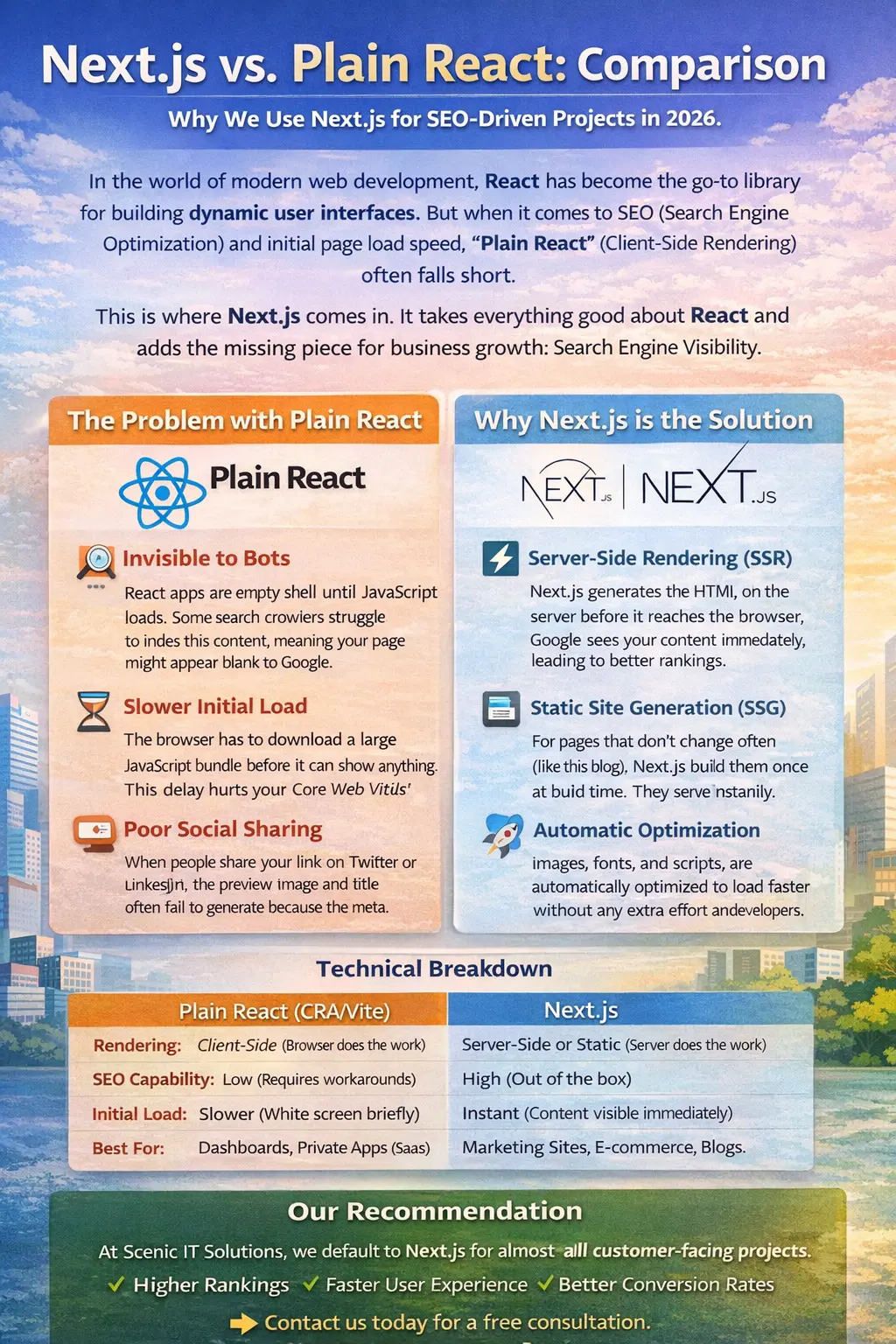
Direct Answer: Is Next.js good for SEO? Yes, Next.js is exceptionally good for SEO. While plain React fails at SEO by using Client-Side Rendering (CSR)—delivering an empty HTML container that forces search bots to execute heavy JavaScript before seeing content—Next.js dominates SEO by delivering pre-rendered Server-Side Rendered (SSR) or Static (SSG) HTML instantly, guaranteeing immediate indexing, complete metadata, and elite Core Web Vitals scores.
At Scenic IT Solutions, our engineering leads build search-optimized web applications with Next.js. Here is the technical breakdown of why Next.js is non-negotiable for organic search in 2026.
⚡ Key Takeaways
- Is Next.js good for SEO? Yes, Next.js dominates plain React for SEO by providing automatic Server-Side Rendering (SSR) and Static Site Generation (SSG).
- Plain React uses Client-Side Rendering (CSR), serving search engine bots an empty HTML shell
<div id="root"></div>that delays indexing. - Google bot defers JavaScript rendering until compute resources are available, causing plain React pages to suffer delayed indexing and missing metadata.
- Next.js achieves vastly superior Core Web Vitals (sub-second LCP and near-zero CLS) through automatic image optimization and route pre-fetching.
- For public-facing websites, content blogs, and e-commerce stores, Next.js is mandatory for organic search engine visibility.
1. Is Next.js Good for SEO? The Fundamental CSR vs. SSR Breakdown
The Direct Answer: Is Next.js good for SEO? Yes, because unlike plain React which relies on Client-Side Rendering (serving an empty page shell and requiring the user's browser to build the DOM), Next.js executes rendering on the server, sending complete semantic HTML with titles, headings, and internal links in the very first HTTP packet.
When you view the page source of a traditional React Single Page Application (SPA), all you see in the HTML body is: <div id="root"></div><script src="bundle.js"></script>. There are no headings, no paragraphs, and no internal anchor links until the multi-megabyte JavaScript file downloads and executes.
2. Why Search Engine Crawlers Struggle with Traditional Single-Page React Apps
The Direct Answer: While Googlebot can technically render JavaScript, it operates on a two-wave indexing system: static HTML is indexed immediately, while JavaScript rendering is queued in a backlog that can delay indexing for days or weeks.
Furthermore, other critical search engines and social platforms (Bing, DuckDuckGo, X/Twitter cards, LinkedIn link previews, Facebook Open Graph) have limited or zero JavaScript rendering capabilities. When they crawl a plain React SPA, they see a blank page with default fallback metadata.
3. How Next.js Solves SEO: Pre-Rendering, Server Components & Dynamic Metadata
The Direct Answer: Next.js automatically pre-renders pages into static HTML on the server, generating dynamic page-level meta tags, Open Graph images, canonical links, and JSON-LD structured data schemas before the page ever reaches the browser.
With React Server Components (RSC) in Next.js App Router, heavy dependencies remain on the server, reducing the client JavaScript bundle to a featherweight fraction of a standard React application.
4. Core Web Vitals Benchmarks: Largest Contentful Paint (LCP) in React vs. Next.js
The Direct Answer: Next.js achieves sub-second Largest Contentful Paint (LCP) because the browser renders text and hero images immediately upon receiving HTML, whereas plain React cannot display LCP elements until its JavaScript bundle finishes compiling.
Next.js also includes built-in next/image and next/font components that automatically serve WebP formats, prevent Cumulative Layout Shift (CLS), and self-host Google Fonts locally. Learn more about Core Web Vitals in our guide on why website speed matters for SEO.
5. Architectural Comparison Matrix: React vs. Next.js for Organic Growth (Table)
The Direct Answer: This comparison matrix highlights the fundamental SEO and architectural capabilities of plain React versus Next.js.
| SEO & Architectural Factor | Plain React (Vite / CRA) | Next.js (App Router SSR/SSG) |
|---|---|---|
| Initial HTML Payload | Empty <div id="root"> shell |
100% Fully populated semantic HTML |
| Googlebot Indexing Speed | Delayed (Second-wave rendering queue) | Instantaneous on first crawl |
| Social Media Link Previews | Fails or displays generic static fallback | Flawless dynamic Open Graph / Twitter cards |
| Largest Contentful Paint (LCP) | Slow (Requires JS execution first) | Sub-second (Pre-rendered server HTML) |
| Automated Image Optimization | Manual developer configuration | Native next/image with WebP conversion |
6. When to Use Plain React and When Next.js Is Mandatory
The Direct Answer: Next.js is mandatory for public-facing websites, e-commerce stores, blogs, and marketing platforms where search traffic generates revenue. Plain React is acceptable only for private, authenticated SaaS dashboards locked behind a login screen.
Golden Architecture Rule: If an anonymous visitor or search engine crawler needs to discover your page on Google, build with Next.js. Never build public landing pages on a client-side SPA.
7. Conclusion: Future-Proofing Your Web Application for Search Engines
The Direct Answer: Migrating to Next.js unlocks the full reactive power of React without sacrificing the organic search visibility, speed, and social sharing capabilities required for digital business growth.
At Scenic IT Solutions, our engineering team specializes in architecting high-performance Next.js web applications and migrating underperforming plain React apps to SEO-dominant SSR platforms. Explore our custom web application development services to get started.
Frequently Asked Questions
Is Next.js good for SEO?
Yes, Next.js is exceptionally good for SEO. Unlike plain React which serves empty HTML to crawlers, Next.js automatically pre-renders pages into static or server-rendered HTML with full meta tags, Open Graph tags, canonical links, and structured JSON-LD schemas, ensuring instant indexing by Google and elite Core Web Vitals scores.
Does Google really struggle to crawl single-page React applications?
Yes. Google Webmaster documentation confirms that JavaScript execution is deferred until rendering resources are free, leading to delayed indexing, missing internal links, and incomplete content extraction.
Is Next.js harder to learn than plain React?
No. Next.js uses standard React components. Developers familiar with React typically become productive in Next.js within a few days, benefiting from its intuitive file-system routing.
Can an existing React application be migrated to Next.js?
Yes! Migration involves moving components into Next.js App Router structure, replacing React Router with Next.js navigation, and swapping client data fetches with server components.
Where can a Next.js application be hosted?
Next.js can be deployed to Vercel, AWS (via AWS Amplify or ECS Docker containers), DigitalOcean App Platform, or self-hosted Node.js Linux servers.
📚 Related Articles & Recommended Reading


Dominate Search Rankings with Next.js Architecture
Are client-side rendering bottlenecks crippling your organic Google rankings? Let Scenic IT Solutions engineer a high-speed Next.js application for your brand.
Consult a Next.js SEO Architect