
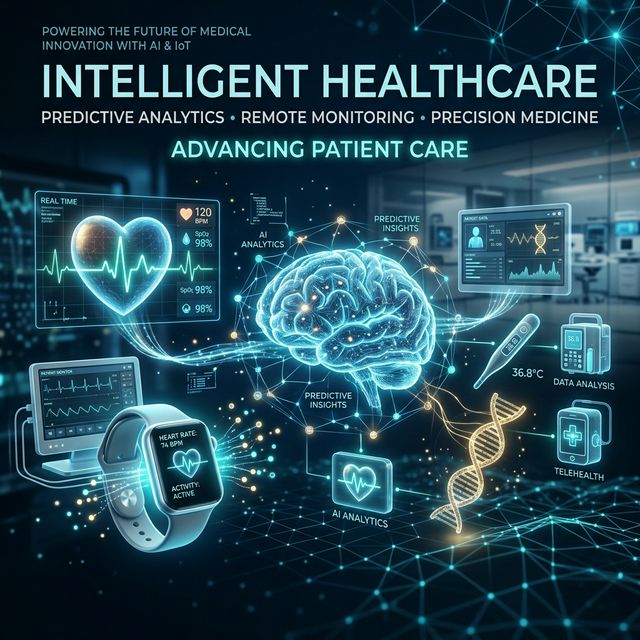
The year 2026 marks a pivotal moment in medical history. The convergence of Artificial Intelligence (AI) and the Internet of Things (IoT) has moved from a futuristic concept to a foundational reality in modern healthcare. This synergy, often referred to as the Internet of Medical Things (IoMT), is redefining patient care, diagnostic accuracy, and operational efficiency globally.
From wearable sensors that predict heart attacks before they happen to AI algorithms that can identify diseases from retinal scans with higher accuracy than human specialists, the healthcare landscape is being rewritten. At Scenic IT Solutions, we witness firsthand how these technologies are empowering healthcare providers to deliver more personalized, proactive, and efficient care.
Artificial Intelligence in 2026 is no longer just about automation; it's about augmentation. AI systems are now capable of processing vast amounts of clinical data — including electronic health records (EHRs), genomic data, and imaging — to identify health risks that were previously invisible.
IoT devices serve as the "nerves" of the modern healthcare system, providing the real-time data that fuels AI diagnostics. In 2026, the Internet of Medical Things has expanded far beyond simple fitness trackers.
The adoption of smart healthcare technologies varies across the globe, driven by government investment, private innovation, and the urgent need to manage aging populations.
| Country | Primary Focus in 2026 | Why it's Popular |
|---|---|---|
| 1. USA 🇺🇸 | AI Drug Discovery & Telehealth | Massive venture capital and a shift toward value-based care models. |
| 2. China 🇨🇳 | Smart Hospitals & AI Diagnostics | Large-scale government support and the world's most extensive 5G network. |
| 3. Germany 🇩🇪 | Digital Health Apps & IoT Security | Strong emphasize on data privacy and federal mandates for digital health tools. |
| 4. United Kingdom 🇬🇧 | Predictive Analytics (NHS) | Usage of AI to manage and optimize national healthcare resource allocation. |
| 5. Israel 🇮🇱 | Cybersecurity & Medical AI Startups | A thriving tech ecosystem focusing on niche AI medical specialties. |
| 6. Japan 🇯🇵 | Elderly Care Robotics & Remote Monitoring | Necessity driven by the world's fastest-aging population. |
| 7. India 🇮🇳 | Telemedicine & Affordable Diagnostics | Scaling healthcare access to rural areas via mobile-first AI solutions. |
| 8. South Korea 🇰🇷 | Bio-Healthcare & AI Wearables | Highly digitalized population and strong tech giants (Samsung/LG). |
| 9. Switzerland 🇨🇭 | Precision Medicine & BioTech | Long history of pharmaceutical excellence moving into the digital age. |
| 10. UAE 🇦🇪 | Smart City Healthcare Integration | Ambitious "Vision 2030" goals to create the world's most advanced hospitals. |
The true magic happens when IoT and AI work together. This integration offers benefits that neither could achieve alone.
Looking toward 2030, we expect to see even deeper integration. "Digital Twins" of individual patients — virtual models powered by real-time IoT data and AI — will allow doctors to simulate the effects of different treatments before applying them in real life. The boundary between hospital-based care and home-based wellness will continue to blur.
AI analyzes medical images and patient data to detect patterns that might be missed by human eyes, enabling earlier and more accurate diagnosis of conditions like cancer or heart disease.
IoT devices like smartwatches and medical sensors track vital signs in real-time, allowing doctors to monitor patients remotely and intervene proactively before a condition worsens.

Whether you're looking to develop a custom medical IoT application or integrate AI-driven diagnostics into your existing platform, Scenic IT Solutions has the expertise to bring your vision to life. We specialize in building secure, compliant, and high-performance medical software for clients across the globe.
Need an expert healthcare development partner? Hire our development team or reach out today for a specialized consultation.