
Smarter Workflows, Stronger Business: Powered by AI Automation in 2026
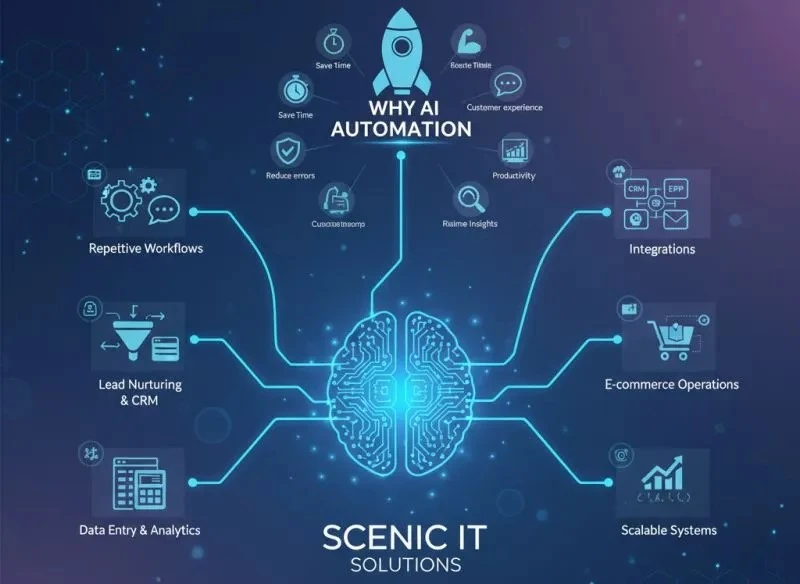
Direct Answer: AI automation services represent the deployment of machine learning models, large language model agents, and intelligent workflow orchestration to automate complex, data-heavy business processes, streamline cross-platform operations, eliminate human error, and reduce operational expenditures by up to 40% without requiring total system overhauls.
⚡ Key Takeaways
- AI automation replaces repetitive, error-prone manual operations with intelligent agentic workflows, lowering enterprise operational costs by 30% to 40%.
- Core enterprise automation domains include customer support copilots, automated invoice parsing, CRM lead enrichment, and end-to-end e-commerce order routing.
- Unlike rigid legacy automation (Zapier, RPA), modern agentic AI reasons dynamically across unstructured data, extracts actionable insights, and self-corrects exceptions.
- Strategic implementation focuses on non-disruptive integration via REST APIs and webhooks, connecting directly with your existing ERPs, CRMs, and databases.
- Partnering with specialized AI engineers ensures bank-grade data privacy, SOC 2 compliance, and zero leakage of proprietary enterprise intellectual property.
1. The AI Automation Revolution: Beyond Simple RPA
The AI automation revolution transitions businesses from brittle, rule-based Robotic Process Automation (RPA) to adaptive, agentic intelligence capable of comprehending unstructured documents, reasoning across ambiguous inputs, and executing multi-step business logic autonomously.
For decades, traditional business automation relied on rigid "if-this-then-that" scripts. The moment a supplier changed a PDF invoice format or a customer phrased an inquiry unexpectedly, legacy automation broke down, requiring manual employee intervention.
In 2026, generative AI models and multi-agent frameworks operate on conceptual understanding rather than rigid syntactical rules. They interpret scanned receipts, extract line items, cross-reference purchase orders in ERP databases, draft contextual email replies, and update accounting ledgers in seconds without human fatigue.
Agentic Intelligence Insight
Modern AI agents don't just process single prompts; they execute multi-turn planning cycles: assessing task objectives, breaking down steps, executing external tool calls via APIs, evaluating execution accuracy, and looping until the business goal is verified complete.
2. High-Impact Enterprise Workflows You Should Automate
High-impact automation opportunities exist in workflows characterized by high transaction volumes, manual data re-keying, document parsing, multi-department approvals, and repetitive multi-channel customer communications.
Organizations implementing intelligent automation realize immediate productivity gains across their most resource-intensive operational departments:
| Business Function | Legacy Manual Process | Intelligent AI Automated Workflow | Documented Efficiency Gain |
|---|---|---|---|
| Customer Support | Human reps answering repetitive FAQs via ticket queues | Autonomous 24/7 AI agents resolving 70%+ of queries instantly | 80% reduction in response time; 65% cost savings |
| Accounts Payable | Manual invoice data entry, PDF parsing, matching POs | Multi-modal OCR & LLMs extracting line items directly into ERP | 90% faster processing; 99.4% extraction accuracy |
| Sales & CRM | Reps researching leads, manual data entry, manual follow-ups | Automated lead enrichment, behavioral scoring, tailored follow-ups | 3x increase in qualified meetings; 10+ hours saved/rep/week |
| E-Commerce Operations | Manual supplier inventory syncing, return verification | Automated stock balancing, shipment tracking, return triage | Real-time inventory sync; 75% faster return approvals |
| HR Onboarding | Manual paperwork validation, credentialing, IT provisioning | AI workflow provisioning accounts, validating IDs, guiding training | New hire onboarding time cut from 5 days to 4 hours |
3. Measurable ROI: How AI Cuts Operational Overhead by 40%
AI automation cuts operational overhead by up to 40% by eliminating wasted employee hours on low-value data entry, preventing costly billing and transcription errors, operating 24/7 without overtime premiums, and scaling capacity without linear headcount expansion.
Consider a mid-market enterprise with 15 operations specialists spending 40% of their workweek re-entering order data, formatting spreadsheets, and drafting routine correspondence. That represents over 12,000 hours of wasted human potential annually—costing upwards of $360,000.
By automating these manual pipelines with intelligent AI connectors, those 15 specialists are liberated to focus on strategic customer retention, complex client negotiations, and product innovation, generating net-new enterprise revenue while cutting operational leakage.
4. Enterprise AI Automation Architecture & Security
Enterprise AI automation architecture requires strict data privacy boundaries, ensuring private customer records are never used to train public foundational models, combined with AES-256 encryption, zero-trust API orchestration, and immutable audit logging.
At Scenic IT Solutions, we engineer automation architectures adhering to enterprise security best practices:
- Private Zero-Retention LLM Gateways: Deploying enterprise API agreements with OpenAI, Anthropic, or self-hosted open-source models (Llama 3) guaranteeing zero training on your corporate data.
- API-First Microservice Connectors: Building bespoke, secure webhook integrations connecting your current software stack (Salesforce, HubSpot, QuickBooks, SAP, custom databases) with zero system disruption.
- Human-in-the-Loop (HITL) Guardrails: Configuring configurable confidence thresholds where high-stakes transactions (e.g., transfers over $5,000) are routed to human supervisors for one-click approval.
5. The 5-Stage Implementation Roadmap with Scenic IT Solutions
A successful AI automation rollout follows a structured 5-stage roadmap: operational workflow auditing, high-ROI pilot prototyping, system integration engineering, user acceptance testing, and continuous performance tuning.
At Scenic IT Solutions, we partner with companies to turn manual processes into intelligent, automated workflows that scale your business. We don't just supply software; we build custom automation engines that fit your exact operations, boost team productivity, and deliver measurable bottom-line profitability.
Frequently Asked Questions
How does AI automation differ from traditional software automation?
Traditional automation requires rigid, pre-defined rules and fails whenever an unexpected input or formatting change occurs. AI automation understands context, natural language, and unstructured data (like scanned PDFs, emails, and phone audio), allowing it to adapt dynamically and handle exceptions without breaking.
Will implementing AI automation require replacing our current software systems?
No. Our engineering team builds intelligent API and webhook connectors that integrate directly into your existing software ecosystem (CRMs, ERPs, databases, email suites), enhancing your current infrastructure without costly platform migrations.
Is our sensitive company and customer data secure with AI automation?
Yes. We utilize enterprise-tier AI infrastructure with strict zero-data-retention policies, meaning your data is never stored or used to train public models. All data transmissions are protected by AES-256 encryption, role-based access controls, and SOC 2 / HIPAA compliance standards.
What is the typical timeframe to deploy a custom AI automation workflow?
A focused, high-impact pilot automation (such as customer support AI or invoice extraction) is typically developed, tested, and deployed to production within 2 to 4 weeks. Multi-system enterprise workflows generally span 6 to 10 weeks.
What kind of ongoing maintenance does an AI automation system require?
AI automations require continuous performance monitoring, periodic prompt and model fine-tuning, API endpoint maintenance, and adaptation as your business rules and software integrations evolve. We provide dedicated SLA maintenance packages to ensure 99.9% uptime.
📚 Related Articles & Recommended Reading
Accelerate Your Digital Roadmap with Scenic IT Solutions
Looking for an experienced web development partner to build high-performance custom applications or scale your engineering team? Let's discuss your project goals.
Schedule a Free Consultation