
Custom Web Application Development: The Complete 2026 Strategy Guide
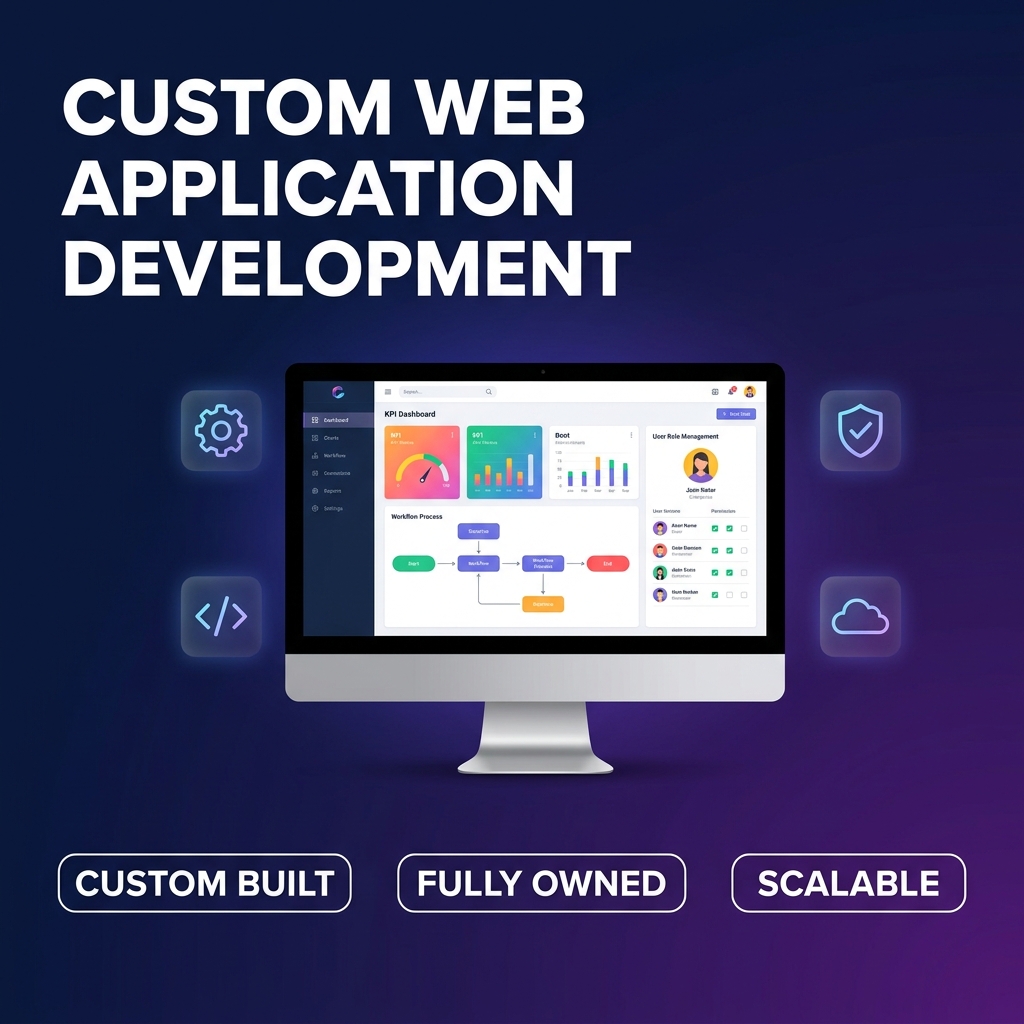
Direct Answer: Custom web application development is the end-to-end engineering of bespoke software accessed via web browsers, designed specifically to automate proprietary business workflows, handle complex data transactions, and scale enterprise operations without the constraints or recurring per-seat licensing costs of pre-packaged SaaS tools.
⚡ Key Takeaways
- Custom web applications are purpose-built software platforms designed around unique business logic, delivering 100% workflow alignment and IP ownership.
- Unlike off-the-shelf SaaS, custom web apps eliminate recurring per-seat licensing fees, third-party vendor lock-in, and restrictive architectural limits.
- Modern web app engineering in 2026 relies on decoupled microservices, cloud-native serverless backends, robust REST/GraphQL APIs, and reactive frontend frameworks.
- Typical development budgets range from $15,000 for early MVPs to $120,000+ for enterprise-grade platforms, with high ROI achieved within 12 to 18 months.
- Rigorous agile methodology—spanning architectural discovery, UI/UX prototyping, iterative sprint delivery, and automated CI/CD—ensures predictable delivery.
1. What Is Custom Web Application Development?
Custom web application development is the process of designing, architecting, coding, and maintaining bespoke web-based software tailored precisely to an organization's proprietary operational workflows, data structures, and user requirements rather than adapting business operations to conform with off-the-shelf commercial software limitations.
Unlike standard marketing websites that primarily broadcast static marketing copy or blog posts to casual visitors, a web application is dynamic, bidirectional software. Users authenticate through secure identity providers, manipulate complex data models, trigger background automated business rules, process transactions, and collaborate in real time.
In 2026, web applications represent the computational backbone of modern industry—powering digital healthcare patient portals, fintech trading desks, supply chain logistics monitors, and customer relationship management (CRM) systems. Because the code is built from the ground up, the enterprise retains absolute intellectual property ownership and zero ongoing licensing penalties.
Enterprise Architecture Tip
When architecting a custom web application, isolate core domain logic from presentation layers using clean API contracts (RESTful or GraphQL). This decouples your frontend UI from backend database migrations, enabling future native mobile app expansion without duplicating business rules.
2. Custom vs Off-the-Shelf: Strategic Decision Matrix
Choosing between custom web application development and off-the-shelf software comes down to strategic differentiation, total cost of ownership over 3 to 5 years, data governance requirements, and whether proprietary workflows grant your organization a defensible competitive advantage in the marketplace.
Commercial SaaS platforms offer rapid initial setup and low upfront onboarding costs. However, as organizations grow in headcount and complexity, per-seat licensing models compound into astronomical annual overhead. Furthermore, businesses inevitably collide with architectural rigidities, forced feature deprecations, and integration bottlenecks that throttle innovation.
Custom software demands a higher initial capital investment but provides limitless integration flexibility, zero recurring user licensing, enterprise-grade data sovereignty, and an asset that adds direct equity value to your enterprise balance sheet.
| Evaluation Dimension | Custom Web Application | Commercial Off-the-Shelf (SaaS) |
|---|---|---|
| Workflow Alignment | 100% matched to proprietary business processes | Forces internal teams to modify operational habits |
| Licensing & TCO | Zero per-user monthly fees; full asset ownership | Compounding per-seat subscription costs forever |
| Data Sovereignty | Full control on dedicated cloud databases & VPCs | Shared multi-tenant database infrastructure |
| Integration Capability | Bespoke webhooks, bi-directional APIs, legacy ERP sync | Restricted to marketplace apps and rate-limited APIs |
| Time to Deployment | 8 to 16 weeks for production-ready MVP | Immediate to 4 weeks configuration time |
| Competitive Advantage | Proprietary IP delivers unique market moat | Identical software features as your direct rivals |
3. Essential Features in Modern Enterprise Web Apps
Modern enterprise web applications must incorporate robust Role-Based Access Control (RBAC), multi-factor authentication, real-time reactive notifications, comprehensive audit logging, seamless third-party API orchestration, and automated exportable reporting dashboards to satisfy high-throughput corporate governance standards.
To deliver measurable operational gains, enterprise web platforms require foundational modules designed for security, observability, and employee productivity:
- Granular Identity & Access Governance: Single Sign-On (SSO) via SAML 2.0 / OpenID Connect (Azure AD, Okta), combined with attribute-based access control down to individual database records.
- Asynchronous Event-Driven Processing: Offloading heavy computations, batch PDF exports, CSV parsing, and AI summarization tasks to background worker queues (Redis, Celery, Laravel Horizon).
- Real-Time Collaborative Interfaces: Utilizing WebSockets and Server-Sent Events (SSE) to display live data changes, presence indicators, and team commentary without browser refreshes.
- Immutable Audit Trails: Timestamped cryptographic transaction logging documenting every record creation, edit, export, and deletion for SOC 2, HIPAA, and GDPR compliance.
4. Selecting the Right 2026 Technology Stack
Selecting the optimal technology stack requires evaluating team developer availability, computational workloads, real-time concurrency demands, time-to-market constraints, and long-term cloud maintenance overhead across frontend, backend, and database tiers.
In 2026, leading engineering teams rely on proven, enterprise-tested web software ecosystems:
- Frontend Presentation Tier: Next.js (React) or Vue 3 / Nuxt delivering server-side rendered (SSR) performant single-page interfaces with TypeScript type safety and Tailwind CSS component systems.
- Backend Application Engine: Node.js (NestJS) for ultra-high concurrency microservices; Laravel (PHP 8.3+) for rapid, secure, monolithic enterprise business portals; Python (FastAPI) for data science and AI integrations.
- Data Persistence & Caching: PostgreSQL for relational ACID compliance and JSONB flexibility, paired with Redis for sub-millisecond memory caching and job queuing.
- Infrastructure & DevOps: Docker containerization orchestrated via Kubernetes, AWS ECS, or automated serverless edge networks with automated GitHub Actions CI/CD pipelines.
5. The End-to-End Engineering Lifecycle
A successful custom web application lifecycle progresses through six structured phases: strategic product discovery, clickable UX/UI interactive prototyping, iterative agile sprints, rigorous automated QA testing, cloud deployment, and proactive post-launch SLA monitoring.
By executing an agile sprint methodology with bi-weekly milestone demonstrations, stakeholders eliminate development risk, review actual working code early, and validate user feedback prior to full production cutover.
- Phase 1: Discovery & Specification: Defining user personas, user journey stories, system architecture diagrams, database schemas, and API contracts.
- Phase 2: Interactive UX/UI Prototyping: Building high-fidelity Figma prototypes with complete design tokens, user testing, and accessibility checks.
- Phase 3: Agile Sprint Development: Bi-weekly sprints producing functional, tested feature increments deployed to staging environments.
- Phase 4: Multi-Layer Testing: Comprehensive unit testing, end-to-end integration tests (Playwright), penetration audits, and load testing.
- Phase 5: Cloud Deployment & Cutover: Zero-downtime blue-green deployments, DNS configurations, and database migration execution.
- Phase 6: Maintenance & Evolution: Real-time APM telemetry (Datadog/Sentry), security patching, feature roadmapping, and scalability tuning.
6. Cost Breakdown and ROI Optimization
Custom web application development costs typically range between $15,000 for focused MVPs to upwards of $120,000 for complex enterprise systems, with initial investment recouped within 12 to 18 months through eliminated SaaS license fees and automated employee hours.
Consider an enterprise paying $150/user/month across 100 employees for disconnected SaaS tools—amounting to $180,000 annually. Investing $60,000 in a unified custom web app saves $120,000 in year one alone, while automating 400+ hours of manual data synchronization between departments.
ROI Acceleration Strategy
Focus your initial Version 1.0 scope exclusively on the 20% of features that drive 80% of business operations. Launching an MVP in 8 to 10 weeks allows actual user telemetry to guide subsequent development iterations, cutting wasted engineering spend by up to 35%.
7. How to Choose the Right Web Development Partner
Selecting the right development agency requires reviewing verifiable case studies, confirming senior developer vetting practices, inspecting architecture documentation standards, ensuring complete code repository ownership, and verifying transparent agile sprint billing models.
At Scenic IT Solutions, our senior engineering teams partner with growth-minded businesses to design, engineer, and deploy high-performance custom web applications built for scale. From day one, you maintain 100% intellectual property ownership, direct Git access, and dedicated project management transparency.
Frequently Asked Questions
What is the average timeline to build a custom web application?
A focused Minimum Viable Product (MVP) typically takes 8 to 12 weeks from initial architectural discovery to production deployment. Complex enterprise platforms with multi-system ERP integrations, advanced workflow automations, and custom reporting suites generally require 16 to 24 weeks.
Do I own the intellectual property and source code of the web app?
Yes. With Scenic IT Solutions, you retain 100% ownership of all source code, design assets, database schemas, and intellectual property upon payment. Code is committed directly to your private repositories from the very first sprint.
How does custom web software compare in long-term cost to SaaS subscriptions?
While off-the-shelf SaaS has lower upfront entry costs, compounding per-seat monthly subscription fees often make it far more expensive than custom software by years 2 and 3. Custom web applications eliminate all user seat licensing and build proprietary balance-sheet enterprise equity.
How do you ensure enterprise security and regulatory compliance?
We implement bank-grade security protocols including AES-256 data encryption at rest, TLS 1.3 in transit, automated vulnerability scanning, strict role-based access control (RBAC), OWASP Top 10 mitigation, and full compliance architecture for SOC 2, HIPAA, and GDPR standards.
Can a custom web application integrate with our existing legacy systems?
Yes. Custom web applications excel at bridging modern cloud microservices with legacy on-premises databases, ERPs (SAP, Oracle), CRM databases (Salesforce), payment processors, and proprietary internal software via secure REST, GraphQL, or webhook integrations.
📚 Related Articles & Recommended Reading


Accelerate Your Digital Roadmap with Scenic IT Solutions
Looking for an experienced web development partner to build high-performance custom applications or scale your engineering team? Let's discuss your project goals.
Schedule a Free Consultation