
The Rise of No-Code & Low-Code Platforms: Strategic 2026 Enterprise Guide
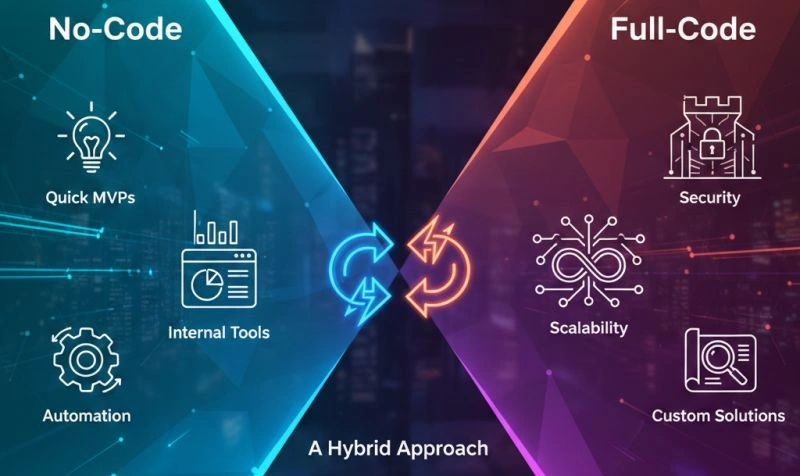
Direct Answer: The rise of no-code and low-code platforms empowers non-developers and technical teams to assemble functional applications visually using pre-built components and graphical interfaces, reducing initial time-to-market while coexisting alongside traditional custom software engineering.
⚡ Key Takeaways
- No-code and low-code platforms have revolutionized software prototyping, enabling rapid MVP delivery and citizen developer productivity.
- No-code platforms excel at internal administrative tools, simple CRM workflows, marketing landing pages, and rapid visual proof-of-concepts.
- Full custom code remains essential for proprietary business algorithms, complex multi-tenant architectures, regulatory compliance, and massive scalability.
- Vendor lock-in, recurring per-user pricing spikes, and limited database indexing represent the primary enterprise risks of pure no-code platforms.
- Forward-thinking enterprises adopt a hybrid approach: building rapid prototypes in low-code while architecting enterprise core backends with custom code.
1. The Explosion of No-Code: Democratizing Software Creation
The exponential growth of no-code and low-code development platforms stems from the global shortage of senior software engineers, the demand for instant internal automation, and the maturation of visual drag-and-drop cloud development environments.
Historically, constructing even a basic internal employee intake form or data dashboard required filing a ticket with overburdened enterprise IT departments, resulting in multi-month backlogs. Platforms like Webflow, Bubble, Retool, and Microsoft Power Apps enabled business analysts and operations managers—often termed "citizen developers"—to build functional tools independently.
In 2026, no-code is no longer dismissed by engineering leaders as a toy. It has become an acknowledged tier in modern software strategy, offering unmatched velocity for early hypothesis testing and internal operations.
2. Where No-Code Truly Shines in the Enterprise
No-code platforms deliver maximum business value when applied to standard, repeatable workflows such as marketing landing pages, internal CRUD admin dashboards, proof-of-concept user validation, and automated lead capture pipelines.
Scenarios where no-code represents the most capital-efficient path forward include:
- Rapid MVP Concept Validation: Testing a digital marketplace or startup concept in 2 weeks rather than spending $50,000 on custom code before validating customer demand.
- Internal Operations & Admin Dashboards: Building internal inventory viewers or customer lookup tools for support teams (using Retool or Appsmith) connected to existing SQL databases.
- Content-Driven Marketing Portals: Empowering marketing teams to publish dynamic landing pages and blogs without bothering frontend development teams for daily updates.
Strategic Insight
Treat no-code as an accelerated discovery vehicle. If an internal tool built in no-code demonstrates 10x ROI and starts straining platform limits, you now have validated user requirements to engineer a permanent, highly scalable custom web application.
3. Where Full Custom Code Still Wins Decisively
Custom software development remains indispensable for proprietary intellectual property, intensive computational tasks, strict regulatory data governance (HIPAA, PCI-DSS), enterprise microservices, and platforms serving hundreds of thousands of concurrent users.
While no-code excels at speed, it encounters immutable brick walls when pushed into high-scale enterprise environments:
- Vendor Lock-In & Portability: Most no-code platforms prohibit exporting underlying backend code. If the platform increases prices by 300% or goes bankrupt, your business software is held hostage.
- Architectural Bottlenecks: You cannot tune database query execution plans, optimize custom memory indexes, or deploy custom WebAssembly algorithms within proprietary no-code containers.
- Runaway Operational Costs: No-code platforms monetize via per-seat licenses, workflow execution runs, or database record caps, creating compounding subscription costs that quickly eclipse the price of custom cloud hosting.
- Data Sovereignty & Compliance: Storing sensitive medical or financial records in shared multi-tenant proprietary no-code databases frequently violates strict institutional regulatory mandates.
4. Architectural Matrix: No-Code vs. Low-Code vs. Custom Code
Understanding when to deploy no-code, low-code, or bespoke custom software requires evaluating project lifespan, budget flexibility, user concurrency, and proprietary competitive differentiation.
| Evaluation Criterion | No-Code (Bubble, Webflow) | Low-Code (Retool, OutSystems) | Custom Code (React, Laravel, Node) |
|---|---|---|---|
| Time to Initial Launch | 1 to 3 weeks | 2 to 6 weeks | 8 to 16 weeks |
| Technical Skill Required | Minimal (Visual logic) | Moderate (JavaScript/SQL) | High (Senior Full-Stack Engineers) |
| Code Ownership & IP | Zero (Proprietary platform) | Partial / Hybrid | 100% Full IP & Source Code Ownership |
| Concurrency & Scale | Low to Moderate | Moderate to High | Virtually Unlimited Cloud Scale |
| Long-Term TCO at Scale | Very High (Usage penalties) | High (Per-seat pricing) | Lowest (Only pay raw cloud compute) |
5. The Future: A Pragmatic Hybrid Development Model
The most competitive technology organizations in 2026 operate a pragmatic hybrid model: utilizing low-code tools for rapid internal tooling while investing their core engineering capital into custom, proprietary web platforms that power customer-facing revenue.
At Scenic IT Solutions, we partner with clients to architect robust custom software, integrate bespoke APIs with low-code frontend dashboards, and build durable digital assets that provide permanent enterprise value.
Frequently Asked Questions
Can a no-code app scale to millions of users?
Generally no. While no-code platforms can handle moderate traffic, their shared database structures, inability to perform micro-level query optimization, and steep usage-based pricing models make scaling to hundreds of thousands of concurrent users financially and architecturally prohibitive compared to custom cloud backends.
What is the biggest risk of relying entirely on no-code for a startup?
The greatest risk is platform dependency and vendor lock-in. If your no-code provider deprecates key APIs, experiences outages, or changes its pricing model, you cannot easily extract and migrate your backend logic elsewhere without rebuilding from scratch in custom code.
What is the difference between no-code and low-code?
No-code requires zero programming knowledge, relying entirely on visual drag-and-drop interfaces. Low-code combines visual interface scaffolding with custom scripting (such as JavaScript, Python, or SQL), allowing developers to write custom code for complex business logic while accelerating frontend layout construction.
When should a business migrate from no-code to custom code?
You should migrate when your monthly platform subscription costs surge, when user transaction latency begins hurting customer satisfaction, or when you need proprietary features and integrations that the no-code builder simply cannot support.
Can Scenic IT Solutions help migrate a no-code prototype into custom software?
Yes. We frequently take validated no-code or low-code prototypes, extract the core data schemas and business rules, and re-engineer them into high-performance custom web applications built on modern frameworks like React, Next.js, Node.js, or Laravel.
📚 Related Articles & Recommended Reading


Accelerate Your Digital Roadmap with Scenic IT Solutions
Looking for an experienced web development partner to build high-performance custom applications or scale your engineering team? Let's discuss your project goals.
Schedule a Free Consultation