
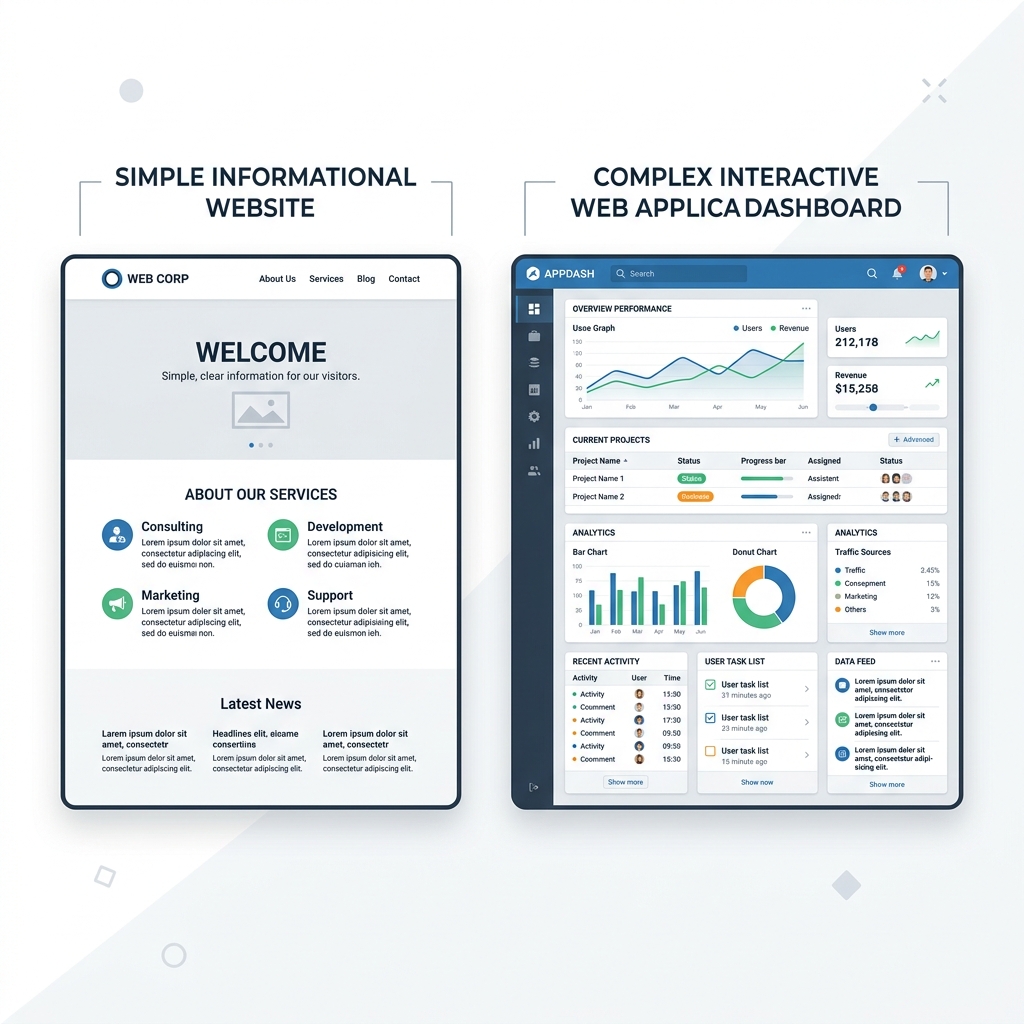
The terms "website" and "web application" are often used interchangeably, but in technical terms, they serve vastly different purposes. Knowing the difference between a web application vs website is critical when planning your budget, timeline, and tech stack in 2026.
A website is a collection of globally accessible, interlinked web pages with a single domain name. Its primary purpose is informational. Users consume the content (text, images, video) but do not actively manipulate the data on the screen. Think of a restaurant's menu page or a corporate blog.
A web application is a software program accessed over the internet using a browser. Its primary purpose is interaction. Users input data, the application processes it, and returns a personalized result. Examples include Gmail, Trello, and online banking portals.
| Feature | Website | Web Application |
|---|---|---|
| Primary Function | To display information and content. | To perform specific tasks and functions. |
| User Interaction | Low (reading, clicking links). | High (submitting forms, manipulating data, logging in). |
| Authentication | Usually none required. | Almost always requires a login/authentication system. |
| Complexity & Cost | Relatively low. | High, requiring databases and complex backend logic. |
A website is primarily informational and static, meant to be read by users. A web application is interactive, requiring user input and data processing to function (like an online banking portal).
Facebook is a highly complex web application because it relies entirely on user interaction, database queries, and real-time updates.
Web applications are significantly more expensive due to the need for backend databases, user authentication, complex logic, and heightened security.

Not sure if your project requires a simple informational site or a robust web application?
Consult with the experts at Scenic IT Solutions. Reach out to us today to define your requirements and build a scalable platform.