
B2B Ecommerce Website Development Services: Solutions & Redesign Guide (2026)
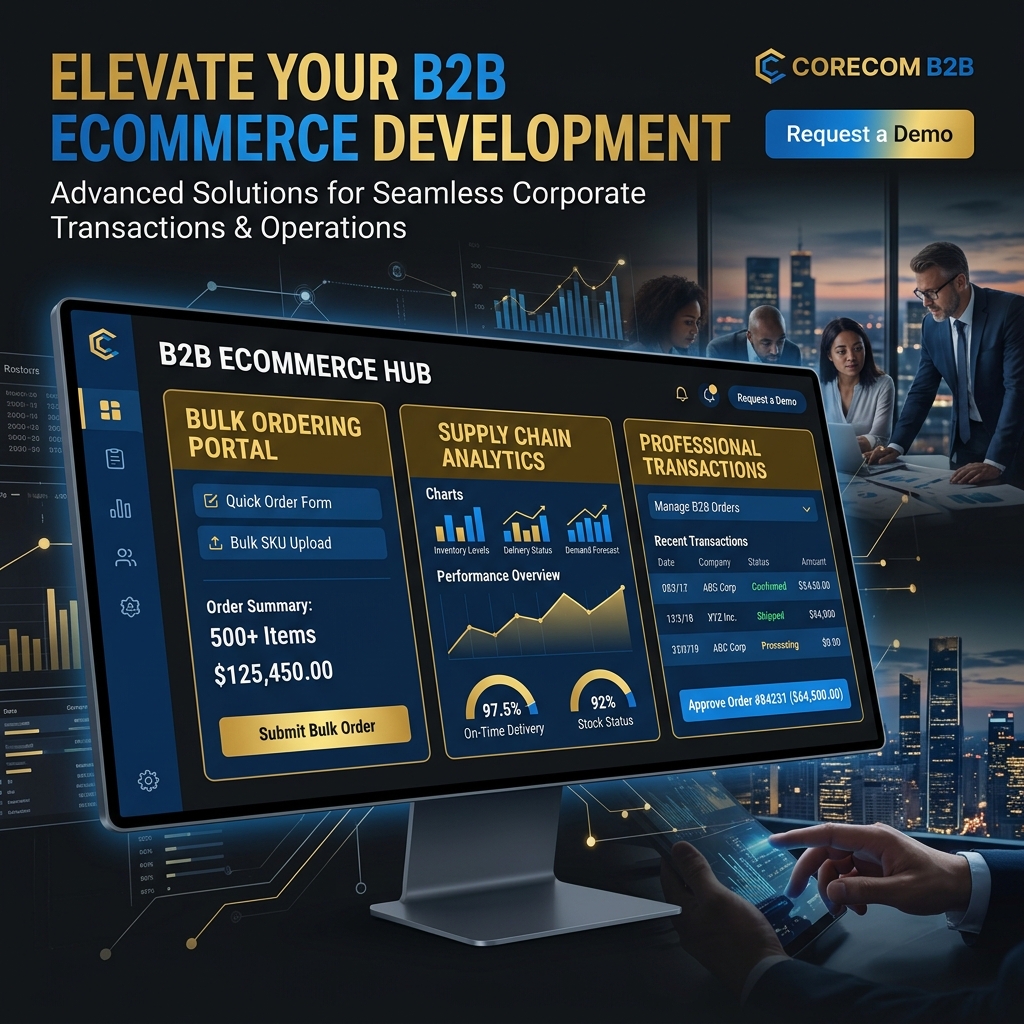
The global B2B e-commerce market has exploded, surpassing five times the volume of consumer B2C retail. Modern wholesale procurement managers and corporate buyers now demand the same intuitive digital convenience they experience on consumer apps—backed by the rigorous commercial workflows unique to corporate commerce.
Direct Answer: B2B e-commerce website development is the engineering of customized B2B ecommerce solutions and wholesale platforms that handle complex commercial purchasing workflows, including customer-specific negotiated contract pricing, bulk SKU ordering, corporate credit terms (Net 30/60), multi-user account approval hierarchies, and bidirectional ERP/CRM synchronization.
At Scenic IT Solutions, our specialized B2B ecommerce developers build robust, enterprise-grade wholesale portals and multi-vendor marketplaces designed to replace manual email and phone orders with automated, high-margin digital revenue channels.
⚡ Key Takeaways
- B2B ecommerce web development differs fundamentally from B2C, requiring customized contract pricing, tiered approval hierarchies, and bulk SKU ordering.
- Integrating ERP, CRM, and warehouse inventory systems in real-time is the single most critical factor for wholesale platform and marketplace success.
- Modern B2B buyers are digital natives who demand self-service reordering, instant invoicing, and flexible credit payment terms (Net 30/60).
- Customized B2B ecommerce solutions built on headless architectures (Laravel, React, Node.js) outperform monolithic CMS platforms with zero checkout lag.
- Planning a B2B ecommerce website redesign reduces corporate sales processing costs by up to 40% while accelerating average order turnaround times.
1. What Is B2B Ecommerce Web Development and What Do B2B Ecommerce Developers Do?
The Direct Answer: B2B ecommerce web development is the specialized discipline of designing, engineering, and integrating software platforms for business-to-business transactions, where B2B ecommerce developers build custom pricing engines, quote workflows (RFQ), and ERP data bridges that standard consumer web developers cannot support.
Corporate buyers do not browse casually with a credit card. They operate under corporate procurement guidelines, require approval from finance managers, need tax-exempt certificates verified, and execute repeat orders involving hundreds of line items.
Failing to accommodate these commercial realities with an off-the-shelf consumer store design frustrates wholesale buyers and drives them back to competitor suppliers.
2. Essential Features of Customized B2B Ecommerce Solutions (CMS & Bulk Portals)
The Direct Answer: Successful customized B2B ecommerce solutions require five core technical capabilities: individualized customer contract pricing tiers, high-speed CSV/SKU bulk ordering pads, automated Net 30 invoicing, dynamic quote generators, and a modular B2B ecommerce CMS with role-based permissions.
- Personalized Contract Pricing: Automatically display individualized negotiated price tiers based on customer login credentials and purchasing volume agreements.
- Bulk Order Pad & CSV Uploads: Allow procurement officers to type in SKU numbers directly or upload spreadsheet manifests to populate thousands of items into cart in seconds.
- Request a Quote (RFQ) Workflow: Enable buyers to assemble large carts and submit them for custom wholesale freight discounts before placing orders.
- Corporate Sub-Account Management: Allow client companies to assign multiple user logins with designated spending caps (e.g., Junior Buyer creates order, Purchasing Manager approves).
3. B2B Marketplace Website Development vs. Single-Vendor Wholesale Storefronts
The Direct Answer: While single-vendor wholesale storefronts sell one distributor's product catalog, B2B marketplace website development creates multi-vendor ecosystems (like Alibaba or ThomasNet) where multiple manufacturers, suppliers, and distributors sell to corporate buyers with automated vendor commission splits, escrow payments, and multi-warehouse routing.
Building a B2B marketplace requires advanced database architecture capable of isolating vendor catalogs, managing complex dispute resolutions, and calculating dynamic LTL (less-than-truckload) freight shipping rates across multiple dispatch facilities simultaneously.
Explore our comparative guide on Shopify vs. WooCommerce vs. Custom Laravel to determine the best platform foundation for your marketplace.
4. Seamless ERP, CRM, and Inventory Integrations for B2B E-Commerce
The Direct Answer: Direct API integration with Enterprise Resource Planning (ERP) systems like SAP, Microsoft Dynamics 365, NetSuite, or QuickBooks ensures real-time synchronization of inventory stock levels, order tracking, and invoice payments.
Without real-time bidirectional ERP integration, your operations team will waste hundreds of hours manually re-keying web orders into legacy accounting systems, introducing shipping delays and inventory discrepancies.
At Scenic IT Solutions, our engineering team builds robust, fault-tolerant middleware APIs that guarantee zero data loss between your e-commerce storefront and core warehouse systems. Learn more about our custom ERP development services.
5. B2B Ecommerce Website Redesign: Modernizing Legacy Wholesale Systems
The Direct Answer: A B2B ecommerce website redesign is necessary when your existing wholesale portal suffers from slow page load speeds, poor mobile responsiveness, manual order processing bottlenecks, or lack of ERP integration, directly causing client churn.
During a strategic redesign, our developers audit your current catalog database, streamline the re-order workflow down to 2 clicks, and transition legacy monolithic systems to a lightning-fast headless frontend (React/Next.js) powered by a robust backend.
6. Top Global Markets Leading B2B Digital Transformation (Data Matrix)
The Direct Answer: This data matrix outlines the leading international markets driving B2B digital commerce adoption and their primary technical focus areas in 2026.
| Country / Region | B2B Digital Adoption Rate | Primary Industry Verticals | Leading Technical Priority |
|---|---|---|---|
| United States | 78% | Manufacturing, Wholesale Distribution, Tech | Self-service customer portals, ERP synchronization. |
| Germany | 74% | Industrial Machinery, Automotive, Chemicals | Automated CAD/CAM integration, strict data privacy. |
| United Kingdom | 71% | Pharmaceuticals, FMCG Wholesale, Electronics | Omnichannel ordering, automated VAT tax compliance. |
| India | 68% | Textiles, Raw Materials, Industrial Supplies | Mobile-first B2B portals, automated GST invoicing. |
| Australia | 65% | Mining Equipment, Agriculture, Healthcare | Complex freight calculation, remote logistics tracking. |
7. Conclusion: Future-Proofing Your Wholesale Digital Business
The Direct Answer: Investing in customized B2B ecommerce solutions transforms wholesale sales operations from an expensive, manual chore into an efficient, 24/7 automated revenue engine.
At Scenic IT Solutions, we engineer scalable, custom B2B web applications tailored to your specific commercial workflows. Discover how we can modernize your wholesale business by exploring our full suite of software development services.
Frequently Asked Questions
Why hire specialized B2B ecommerce developers instead of standard web agencies?
B2B ecommerce developers understand corporate commerce mechanics: customer-specific contract pricing, multi-tier corporate buyer approval hierarchies, Net 30 credit workflows, and bidirectional ERP/CRM synchronization that standard B2C web agencies lack experience with.
How does B2B marketplace website development differ from standard wholesale stores?
A standard wholesale store sells products from a single company. A B2B marketplace enables multiple independent vendors and manufacturers to list catalogs, manage individual inventory, receive automated commission payouts, and fulfill purchase orders through a unified digital platform.
What should be prioritized during a B2B ecommerce website redesign?
A B2B ecommerce website redesign should prioritize sub-second page speed, 1-click repeat reordering, mobile procurement optimization, live ERP inventory synchronization, and flexible payment terms (PO checkout and Net terms).
Which B2B ecommerce CMS or framework is best for customized solutions?
For mid-market and enterprise manufacturers, custom headless Laravel or Node.js paired with a React frontend provides superior pricing calculation speed, database flexibility, and security compared to rigid monolithic CMS templates.
What is the average development cost for a custom B2B ecommerce website?
A dedicated custom B2B wholesale platform generally ranges from $15,000 to $60,000+ depending on the complexity of ERP/CRM integrations, custom pricing matrix logic, and corporate approval workflows.
📚 Related Articles & Recommended Reading


Hire Top B2B Ecommerce Developers Today
Streamline wholesale orders, eliminate manual processing errors, and provide your business buyers with a world-class digital ordering experience.
Request a B2B Project Proposal