
Enterprise Resource Planning (ERP) is the brain of a modern corporation. It connects finance, human resources, supply chain, and operations into a single, cohesive database. In 2026, relying on fragmented spreadsheets and isolated software tools is a recipe for operational failure.
While giants like SAP and Oracle dominate the landscape, mid-sized and large enterprises are increasingly turning to custom ERP development. Off-the-shelf solutions are notoriously complex, often requiring businesses to change their proven workflows to match the software. A custom ERP does the exact opposite: it is molded entirely around how your business actually works.
Investing in a custom ERP is a strategic decision that offers profound long-term advantages.
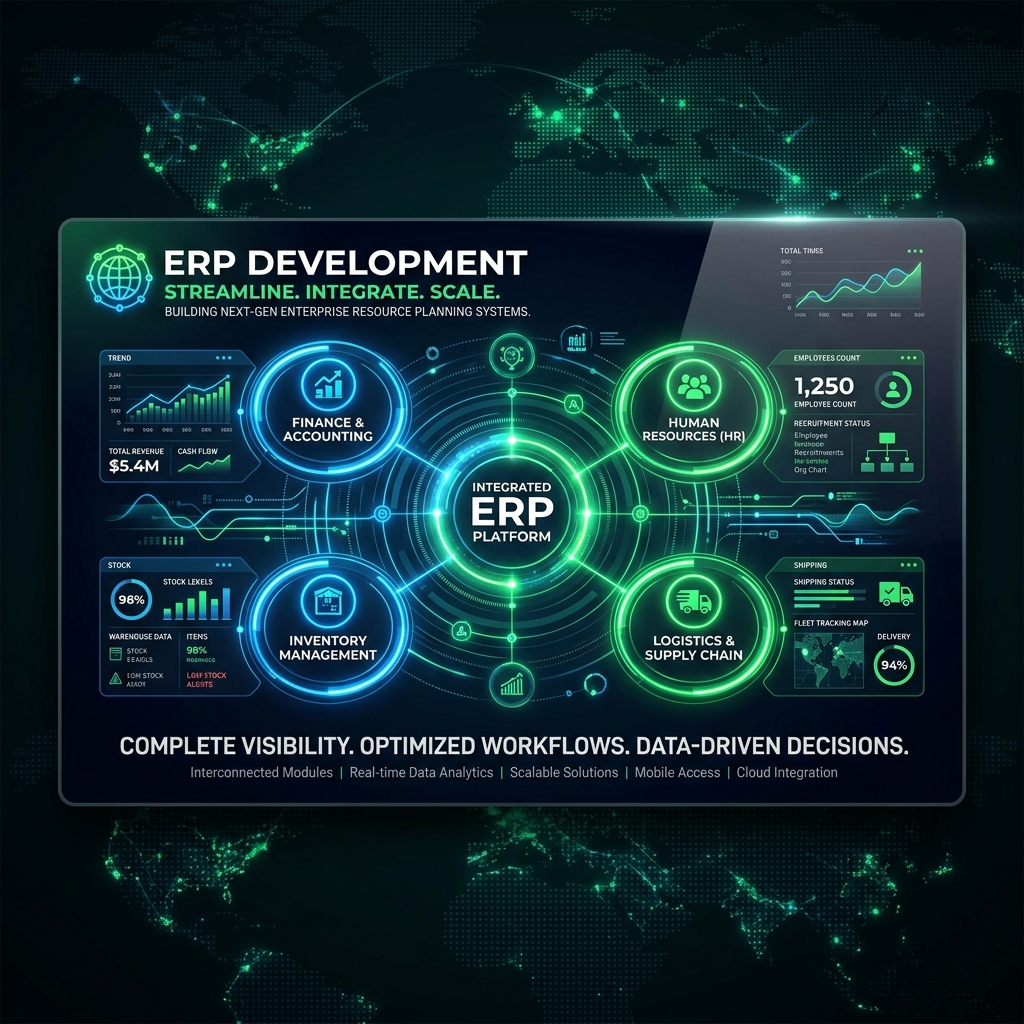
Every custom ERP is different, but most rely on a core set of interconnected modules:
Finance & Accounting: Real-time ledger updates,
automated invoicing, and tax compliance tracking.
Inventory & Supply Chain: Automated reordering,
barcode/RFID integration, and supplier performance metrics.
Human Resources (HRMS): Payroll processing, leave
management, and employee performance reviews.
Customer Relationship Management (CRM): Linking
sales data directly to inventory and revenue projections.
The shift away from rigid enterprise software is happening globally. Here are the leaders.
| Country | Industry Focus | Why it's Popular |
|---|---|---|
| 1. Germany 🇩🇪 | Manufacturing & Industry 4.0 | Deep integration of ERPs with factory floor robotics and IoT sensors. |
| 2. USA 🇺🇸 | Retail & SaaS Ecosystems | High demand for agile, cloud-native ERPs that integrate with modern web apps. |
| 3. Japan 🇯🇵 | Automotive & Logistics | Focus on highly precise, Lean-manufacturing compatible resource planning. |
| 4. India 🇮🇳 | Development & SMB Digitization | The primary global hub for engineering and developing custom ERP systems. |
| 5. UK 🇬🇧 | Financial Services | Developing highly secure, audit-ready ERPs for strict regulatory environments. |
| 6. China 🇨🇳 | Supply Chain & Wholesale | Massive scale systems to handle global export and complex supplier networks. |
| 7. South Korea 🇰🇷 | Electronics & Shipbuilding | Real-time resource tracking utilizing hyper-fast 6G infrastructure. |
| 8. Canada 🇨🇦 | Natural Resources & Energy | Custom modules built for remote operations and heavy equipment tracking. |
| 9. Australia 🇦🇺 | Mining & Agriculture | Offline-first capability modules for regions with intermittent connectivity. |
| 10. Brazil 🇧🇷 | Agri-Tech & E-commerce | Modernizing traditional sectors with mobile-first ERP interfaces. |
In 2026, an ERP without AI is just a database. Machine learning algorithms are now embedded to predict inventory shortages before they happen, detect anomalous financial transactions in real-time, and automatically route supply chain logistics around global disruptions.
Building a custom ERP is the ultimate act of digital transformation. It breaks down data silos, aligns every department toward a common goal, and provides executives with the uncompromised data required to make rapid, strategic decisions.
Custom ERPs are tailored to specific, unique business workflows and eliminate massive ongoing licensing fees, providing better long-term ROI and easier user adoption.
Core modules typically include Finance & Accounting, Human Resources, Supply Chain & Inventory Management, and CRM integration.
Stop forcing your business to fit inside rigid, expensive software. At Scenic IT Solutions, we build custom ERP platforms from the ground up, designed exactly for your unique operational needs.
Ready for true digital transformation? Hire our enterprise developers or schedule a technical consultation today.