
Custom CRM vs. Off-the-Shelf Software: Which Is Right for Your Business?
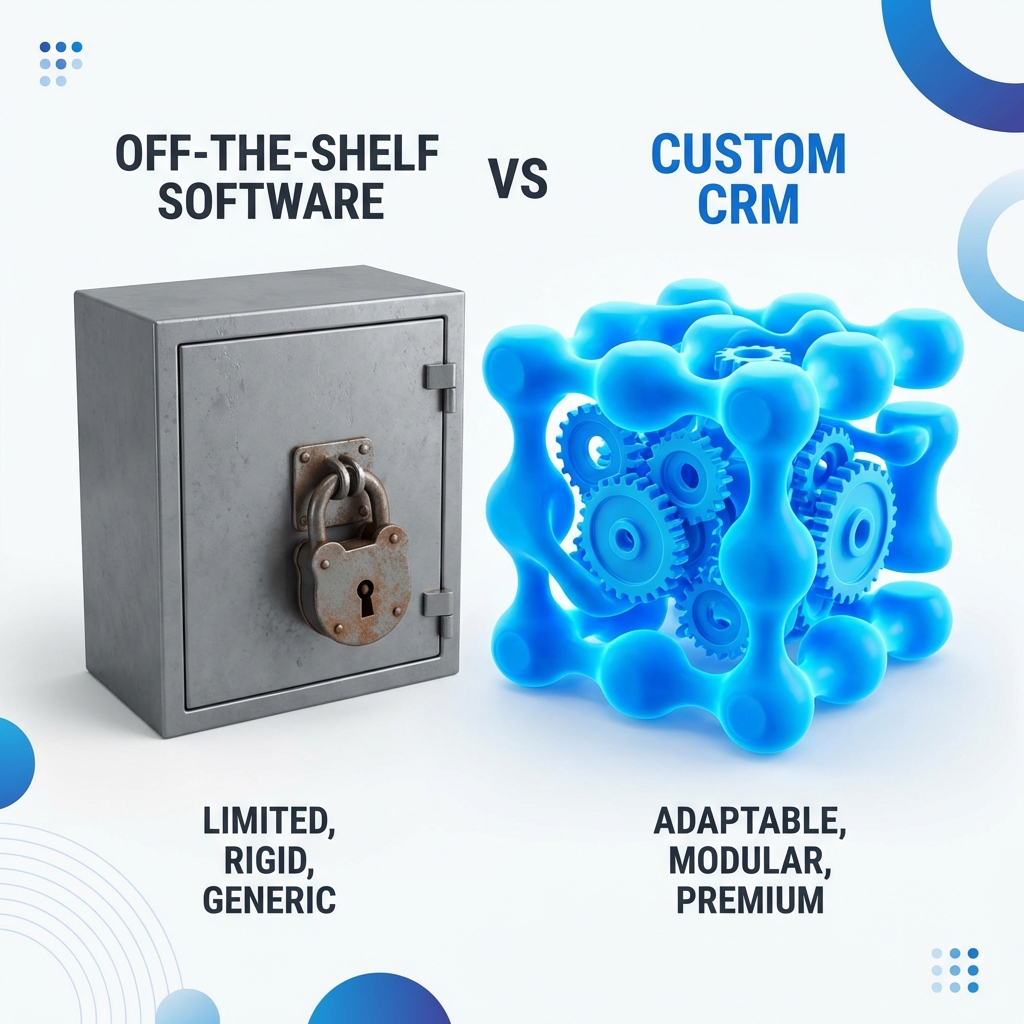
Every growing organization reaches a pivotal crossroads in customer relationship management: should you continue paying escalating monthly subscription fees for commercial SaaS tools like Salesforce, HubSpot, or Zoho, or is it time to invest in a proprietary custom CRM?
Direct Answer: Off-the-shelf CRMs are best for small teams (under 15 users) with standard sales funnels seeking instant setup, while custom CRM development is the superior financial and operational choice for mid-sized and enterprise businesses with specialized workflows, high user counts, or proprietary customer data models, typically achieving a full ROI break-even within 14 to 20 months.
At Scenic IT Solutions, we help companies evaluate their technology investments objectively. Here is our comprehensive comparison of building vs. buying CRM software in 2026.
⚡ Key Takeaways
- Off-the-shelf CRMs (Salesforce, HubSpot) offer fast initial setup but charge punitive per-seat subscription fees that escalate as your team expands.
- Custom CRMs require upfront capital investment but carry zero recurring user licensing costs, resulting in massive 5-year financial savings.
- Companies with unique proprietary workflows, specialized compliance rules, or bespoke manufacturing steps outgrow pre-built SaaS rapidly.
- The average break-even point for custom CRM software is between 14 and 20 months for teams with 25 or more active users.
- Building custom guarantees complete data sovereignty, customized AI integrations, and zero risk of sudden vendor price hikes.
1. The Fundamental Choice: Pre-Built SaaS Subscriptions vs. Bespoke Ownership
The Direct Answer: Buying off-the-shelf software is essentially "renting" an apartment—you move in immediately, but you cannot knock down walls and your rent increases annually. Building a custom CRM is "owning" a home—requiring upfront capital, but tailored to your lifestyle with zero rent.
Commercial CRM providers make their fortunes on per-seat pricing tiers. What begins as an affordable $50/user/month plan quickly doubles as you unlock essential enterprise features like custom reporting, API access, and advanced automation.
2. Off-the-Shelf CRM Pros and Cons: Immediate Launch vs. Feature Bloat
The Direct Answer: Commercial CRMs launch in hours and include thousands of pre-built integrations, but force your team to adapt their business processes to rigid software constraints while suffering from overwhelming interface bloat.
- Advantages: Instant deployment, managed cloud hosting, automated software updates, and native app store ecosystems.
- Disadvantages: Extortionate per-user fees, complex workarounds for non-standard sales cycles, aggressive data export limits, and unexpected platform price hikes.
3. Custom CRM Pros and Cons: Initial Investment vs. Tailored Workflows
The Direct Answer: Custom CRMs match your internal company vocabulary and workflows with 100% precision, carrying zero per-seat fees, but require an initial engineering timeline of 10 to 16 weeks and upfront capital.
With a custom CRM, your sales and support staff only interact with the exact modules they need. Adoption rates skyrocket because the software is intuitive and built around the way your company actually closes deals. Learn more about our specialized custom CRM development services.
4. Direct Comparison Matrix: Custom CRM vs. Off-the-Shelf SaaS (Table)
The Direct Answer: This comparison matrix highlights the key operational, financial, and technical distinctions between custom development and pre-built SaaS.
| Feature / Factor | Custom CRM Platform | Off-the-Shelf SaaS (HubSpot / Salesforce) |
|---|---|---|
| Deployment Time | 10 – 16 Weeks (Engineered to Spec) | Immediate (Days for basic setup) |
| Licensing Costs | $0 per user (100% Owned) | $50 – $250+ per user / month |
| Workflow Fit | 100% Tailored to proprietary processes | Generic; requires adapting to software limits |
| Data Ownership | 100% Private database on your cloud | Vendor-hosted; subject to API limits |
| 3-Year Cost (50 Users) | $50k – $80k Total (Build + Hosting) | $150k – $300k+ in subscription fees |
5. Financial Analysis: The 3-Year Break-Even Point of Custom CRM Software
The Direct Answer: For an organization with 30 active CRM users, commercial SaaS subscriptions average $45,000 annually. A custom CRM build costing $55,000 achieves full financial break-even by month 15, generating tens of thousands in pure capital savings every year thereafter.
Discover how custom web applications save capital across operational departments in our guide on how web apps save money and grow your business.
6. Decision Framework: When Should You Build Custom vs. Buy SaaS?
The Direct Answer: Buy off-the-shelf if your team has fewer than 15 users, a standard B2C or simple B2B sales cycle, and needs to launch this week. Build custom if you have 20+ users, complex manufacturing or service workflows, or proprietary customer data.
Golden Decision Rule: If your customer relationship workflow is a core source of competitive differentiation in your industry, never outsource it to generic off-the-shelf software used by all your competitors.
7. Conclusion: Selecting the Software Strategy That Fuels Your Growth
The Direct Answer: Choosing between custom CRM development and off-the-shelf software is fundamentally a strategic question of long-term operational efficiency versus short-term convenience.
At Scenic IT Solutions, we help companies design, engineer, and deploy high-performance custom CRM and ERP software that scales seamlessly. Explore our full range of web development services to discover how we can elevate your software infrastructure.
Frequently Asked Questions
Can a custom CRM integrate with my existing email and calendars?
Yes. Custom CRMs integrate directly with Google Workspace, Microsoft Outlook, and Exchange APIs to automatically log two-way email communications and calendar meetings.
What technologies are used to build a custom CRM?
Modern custom CRMs are built using robust backend frameworks like Laravel or Node.js, fast responsive frontends like React or Vue.js, and scalable PostgreSQL or MySQL databases.
Is it risky to build a custom CRM instead of buying from an established vendor?
Not when partnering with an experienced development firm that follows modular architecture, comprehensive documentation, and modern automated testing. You retain 100% code ownership, eliminating vendor lock-in.
Can custom CRMs support mobile devices for remote sales teams?
Yes. We build responsive Progressive Web Applications (PWAs) that allow field sales representatives to access customer data, update deal stages, and log calls directly from their smartphones.
How do we handle software updates and new features for a custom CRM?
Scenic IT Solutions provides ongoing support retainers, allowing you to add new custom modules, update integrations, and optimize performance as your business operations evolve.
📚 Related Articles & Recommended Reading


Free Your Business from Expensive CRM Licensing
Ready to build a proprietary customer management platform with zero recurring seat fees? Discuss your CRM roadmap with the senior architects at Scenic IT Solutions.
Request a CRM Architecture Session