
Shopify vs WooCommerce vs Custom Laravel: The Ultimate E-Commerce Platform Guide (2026)
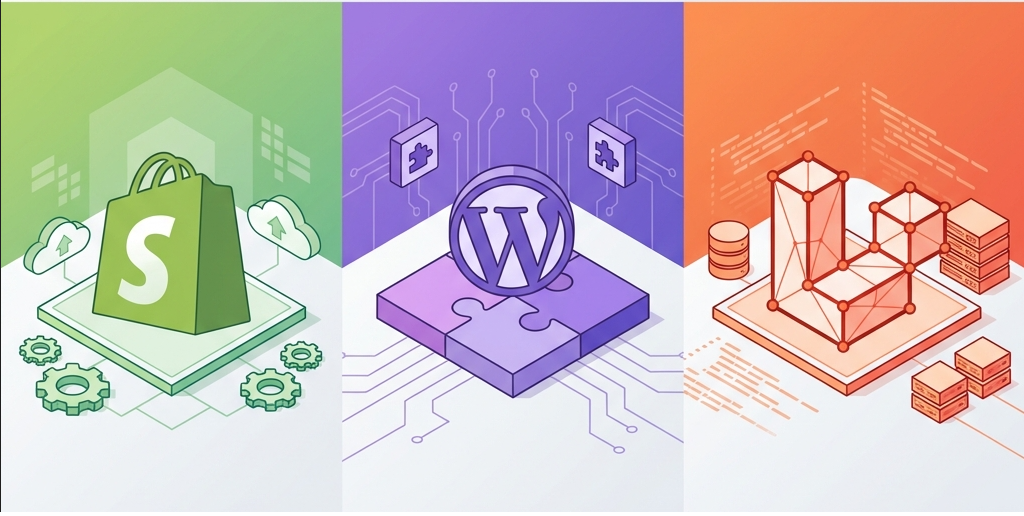
Choosing an e-commerce platform is not just a marketing decision; it is the fundamental technological engine that dictates your business profit margins, checkout speed, and operational scalability.
Direct Answer: Shopify vs WooCommerce for ecommerce platforms: which offers better ease of setup, app ecosystem, transaction fees, and scalability? Shopify wins decisively on ease of setup and turnkey app ecosystem, while WooCommerce wins on zero transaction fees and open-source flexibility. However, for high-volume enterprise stores ($2M+ GMV) and complex B2B wholesale portals, Custom Laravel E-Commerce provides superior long-term scalability, database sovereignty, and zero platform taxes.
At Scenic IT Solutions, we engineer and scale e-commerce applications across all three foundations. Here is your definitive 2026 platform evaluation.
⚡ Key Takeaways
- Shopify delivers superior ease of setup and a massive app ecosystem, but penalizes scaling stores with monthly app subscriptions and transaction taxes.
- WooCommerce provides open-source WordPress flexibility, zero platform transaction fees, and full template control for content-driven stores.
- Custom Laravel e-commerce delivers unlimited architectural freedom, bespoke ERP/CRM integration, and zero recurring platform fees for enterprise brands.
- Stores generating over $2M annually often find Shopify's 0.5%–2% transaction fees and app subscription bloat more expensive than maintaining a custom Laravel platform.
- Database sovereignty: Custom Laravel stores store 100% of customer and order records in proprietary databases with zero third-party platform lock-in.
1. Shopify vs WooCommerce: Ease of Setup, App Ecosystem, Transaction Fees & Scalability
The Direct Answer: Comparing Shopify vs WooCommerce directly: Shopify offers faster ease of setup (launch in 1 day) and a vetted 8,000+ app store, but charges 0.5%–2.0% transaction fees unless using Shopify Payments; WooCommerce offers 0% transaction fees and unlimited WordPress customization, but requires manual hosting setup and developer maintenance.
For non-technical founders, Shopify eliminates technical anxiety. For developer-led teams, WooCommerce provides full control over PHP templates, database queries, and custom checkout funnels.
2. Customization Limits, Database Sovereignty & Unique Workflows
The Direct Answer: Shopify restricts checkout modifications (unless paying $2,300/mo for Shopify Plus) and limits product data structures; WooCommerce allows full PHP/CSS customization; and custom Laravel offers unlimited architectural freedom.
If your business requires multi-tiered B2B pricing, automated custom manufacturing calculators, or deep synchronization with proprietary ERP software, Shopify's closed API sandbox will become a frustrating bottleneck.
3. Transaction Fees, App Subscriptions & Hidden Platform Taxes
The Direct Answer: Shopify charges an additional 0.5% to 2.0% transaction fee if you use third-party payment gateways, plus hundreds of dollars in monthly app subscriptions; WooCommerce and Laravel carry zero platform transaction fees.
For a store processing $3,000,000 annually, Shopify's extra transaction fees and app licenses cost over $35,000 every single year. On custom Laravel, that capital remains in your profit margin.
4. High-Volume Scalability and Performance Under Peak Traffic (Table)
The Direct Answer: This comparison matrix analyzes the technical scalability, performance overhead, and architectural control of each platform.
| Factor | Shopify | WooCommerce | Custom Laravel E-Commerce |
|---|---|---|---|
| Hosting & Infrastructure | Fully managed closed cloud | Self-hosted WordPress cloud | High-performance dedicated cloud (AWS / DO) |
| Transaction Platform Tax | 0.5% – 2.0% unless using Shopify Payments | 0% Platform Fee | 0% Platform Fee |
| Checkout Customizability | Locked (Requires Shopify Plus) | Full PHP/CSS template access | 100% Bespoke 1-step checkout funnel |
| Complex B2B Logic | Limited (Requires enterprise add-ons) | Supported via specialized plugins | Native, unlimited custom business rules |
| Data Sovereignty | Stored in Shopify's proprietary cloud | Self-hosted MySQL database | 100% Private, encrypted database ownership |
5. 5-Year Total Cost of Ownership (TCO) Comparison
The Direct Answer: While custom Laravel development requires a higher upfront build cost ($25k–$60k), it eliminates thousands of dollars in monthly app subscriptions and transaction taxes, resulting in a substantially lower 5-year TCO for high-volume merchants.
Explore detailed project budgeting in our guide on the cost of custom web app development in 2026.
6. Strategic Decision Framework: Choosing the Right Engine for Your Scale
The Direct Answer: Choose Shopify if you are a retail startup with under $500k in annual sales; choose WooCommerce if you run a content-rich WordPress business; choose custom Laravel if you process over $2M annually or run complex B2B workflows.
Enterprise Rule: When your e-commerce operations become your primary competitive differentiator, building custom software protects your margins and guarantees total independence from third-party platform policy shifts.
7. Conclusion: Building an E-Commerce Platform That Grows Without Limits
The Direct Answer: The best e-commerce platform is the one that scales gracefully alongside your commercial ambitions without holding your data, checkout funnel, or profits hostage.
At Scenic IT Solutions, our engineering team builds custom e-commerce applications, B2B wholesale portals, and high-performance retail engines. Explore our B2B e-commerce guide or contact our solutions team to engineer your online store.
Frequently Asked Questions
Shopify vs WooCommerce for ecommerce platforms: which offers better ease of setup, app ecosystem, transaction fees, and scalability?
Shopify wins on ease of setup and turnkey app ecosystem, allowing non-technical merchants to launch in 24 hours. WooCommerce wins on 0% platform transaction fees and open-source data ownership. For enterprise scalability beyond $2M GMV, custom Laravel provides superior database speed, custom checkout flows, and zero platform taxes.
Can a custom Laravel store handle high traffic during flash sales?
Yes. With Laravel Octane, Redis caching, and horizontal cloud load balancing, custom Laravel e-commerce stores easily process thousands of concurrent checkouts with sub-second page response times.
Why do high-volume merchants leave Shopify for custom Laravel?
Merchants migrate away from Shopify to eliminate expensive transaction fees, escape rigid checkout customization limits, and integrate proprietary ERP and warehouse logistics directly into their database.
Is WooCommerce completely free to run?
The WooCommerce core software is free, but high-traffic stores require optimized cloud hosting ($50–$200/mo) and premium extensions for advanced shipping, subscriptions, and security.
Can I migrate customer and order data from Shopify to Laravel?
Yes. All historical customer accounts, product catalogs, and order records can be exported via Shopify REST API and migrated cleanly into a custom Laravel database.
📚 Related Articles & Recommended Reading


Build an Enterprise-Grade E-Commerce Platform
Ready to escape platform transaction taxes and build a custom e-commerce engine tailored to your exact business model? Partner with Scenic IT Solutions.
Consult an E-Commerce Architect