
Angular vs React vs Vue in 2026: The Ultimate Frontend Framework Guide

The frontend JavaScript ecosystem is the most vibrant and fiercely debated sector in modern software engineering. For over a decade, three titans have dominated client-side application architecture: Angular, React, and Vue.js.
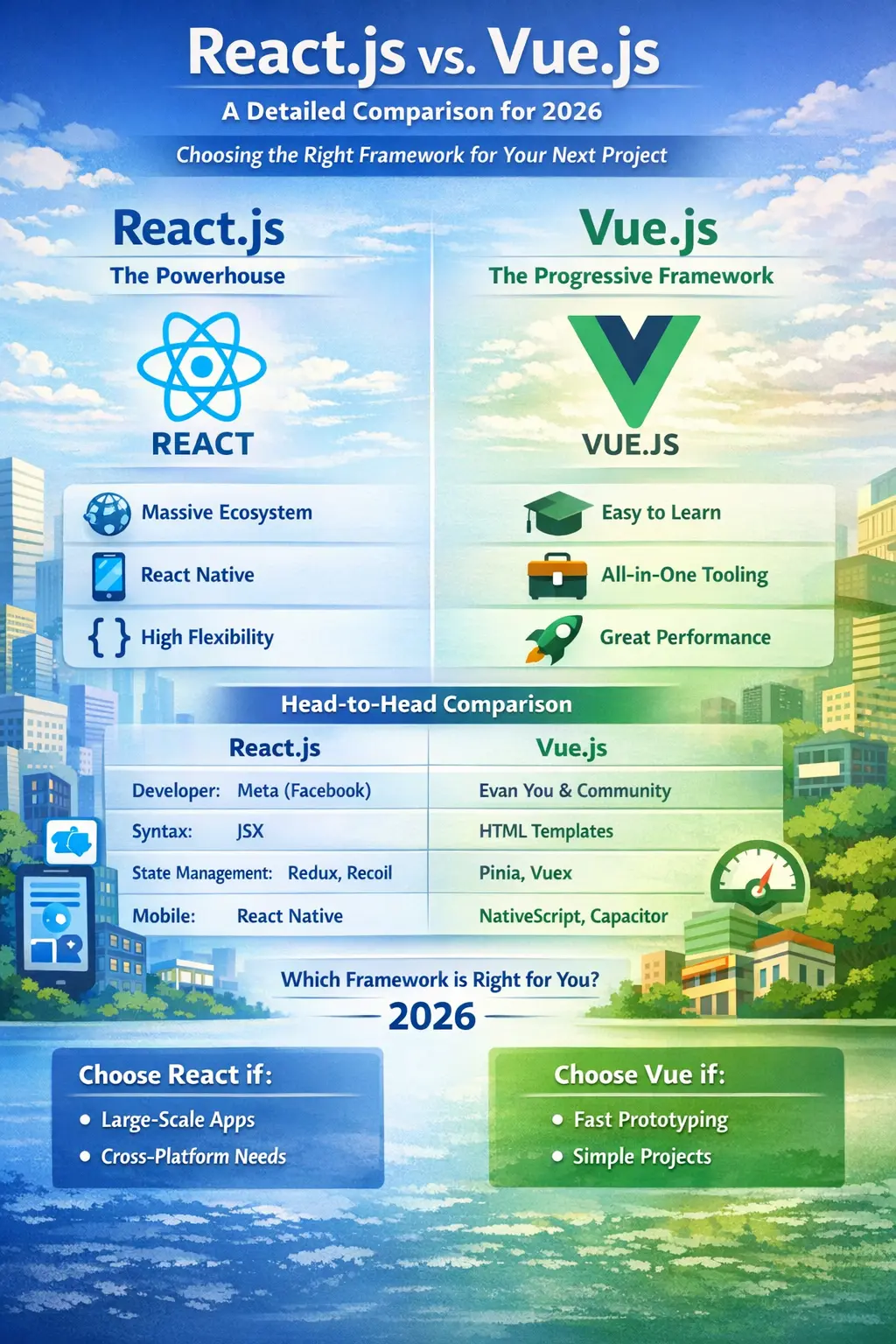
Direct Answer: In 2026, React is the dominant global choice for scalable web applications requiring massive component ecosystems and Next.js SSR; Angular is the premier all-in-one enterprise suite for large corporate teams demanding strict TypeScript conventions; and Vue.js is the developer favorite for clean syntax, rapid learning curves, and progressive component integration.
At Scenic IT Solutions, our frontend teams architect production interfaces across all three frameworks. Here is our authoritative 2026 technical comparison.
⚡ Key Takeaways
- React remains the undisputed global market leader, powered by Meta, Next.js server components, and the largest developer hiring pool.
- Angular provides an all-in-one enterprise powerhouse with strict TypeScript conventions, dependency injection, and built-in routing/testing.
- Vue.js delivers the smoothest learning curve and developer ergonomics with its intuitive Single-File Components (.vue) and Vite build tooling.
- Angular suits massive enterprise teams requiring rigid standardized architecture; React suits dynamic, scalable products; Vue suits rapid delivery.
- The United States, India, Germany, and the UK dominate global frontend hiring across all three major ecosystems.
1. The Big Three Ecosystems: Component Architecture & Philosophy
The Direct Answer: React is an unopinionated UI library focusing on virtual DOM rendering; Angular is a complete full-featured enterprise framework; and Vue.js is a progressive, incrementally adoptable framework blending the best of both worlds.
React leaves routing, state management, and build tools up to the developer. Angular enforces rigid architectural patterns (TypeScript, RxJS observables, dependency injection) out of the box. Vue offers gentle progressive adoption: you can drop it into a static HTML file via CDN or build complex enterprise SPAs using Vite.
2. Learning Curve, Developer Ergonomics & Tooling Maturity
The Direct Answer: Vue has the gentlest learning curve due to familiar HTML/CSS/JS template separation; React requires mastering JSX and modern hook state flows; Angular has the steepest learning curve due to complex TypeScript abstractions and RxJS.
However, Angular's strictness is its greatest enterprise strength. Because Angular prescribes how services, models, and components interact, large engineering teams can rotate developers across projects with zero architectural confusion.
3. Runtime Performance, Virtual DOM & Bundle Size Benchmarks
The Direct Answer: All three frameworks achieve 60fps rendering in modern browsers, with Vue and React delivering lighter initial bundle payloads (35–45KB), while Angular utilizes modern signals and fine-grained change detection to match performance on complex enterprise screens.
In 2026, server-side rendering (SSR) frameworks—such as Next.js for React, Nuxt for Vue, and Angular Universal—ensure that all three platforms achieve top-tier Google Core Web Vitals and instant first-paint speeds. Learn more in our guide on Next.js for SEO.
4. Enterprise Scale: Angular Opinionated Architecture vs. React Flexibility
The Direct Answer: Fortune 500 banks, healthcare networks, and telecom companies lean heavily toward Angular for its built-in security, long-term stability, and dependency injection, while high-growth SaaS and tech startups overwhelmingly adopt React.
React's immense popularity gives companies access to the largest developer hiring pool on earth, simplifying staff expansion and engineering contractor sourcing.
5. Feature Comparison Matrix: Angular vs. React vs. Vue (Table)
The Direct Answer: This comparison matrix summarizes the key architectural, performance, and operational distinctions across the Big Three frameworks.
| Feature / Factor | Angular (Google) | React (Meta) | Vue.js (Community) |
|---|---|---|---|
| Classification | Full-Fledged Framework | UI Component Library | Progressive Framework |
| Language Syntax | Strict TypeScript mandatory | JavaScript (JSX) or TypeScript | HTML templates + JS/TS |
| Data Binding | Two-way data binding | One-way unidirectional flow | Two-way v-model binding |
| State Management | Services, Signals, NgRx | Context, Redux, Zustand, Recoil | Pinia (Official), Vuex |
| Ecosystem Scale | Massive Enterprise / Corporate | Largest Global Community (#1) | Very High Global Community |
6. Top 10 Countries Leading Frontend Framework Usage (Data Matrix)
The Direct Answer: The United States and India represent the largest development ecosystems for React and Angular, while China, France, and Japan lead global adoption of Vue.js.
Review our dedicated country reports on the top 10 countries using React JS and top 10 countries using Vue JS.
7. Final Recommendation: Which Framework Should You Choose in 2026?
The Direct Answer: Choose React (with Next.js) if you want the largest talent pool and maximum flexibility; choose Angular if you manage a 50+ person enterprise team needing rigid consistency; choose Vue.js if you want fast development with clean, elegant code.
At Scenic IT Solutions, our frontend architects build high-performance web applications across React, Vue, and Angular. Explore our custom web application development services to consult with our UI engineering leads.
Frequently Asked Questions
Which framework is most popular among employers in 2026?
React remains the most in-demand frontend technology by a wide margin, accounting for over 50% of all frontend developer job postings worldwide, followed by Angular and Vue.js.
Is Angular harder to learn than React?
Yes. Angular requires mastering complex concepts like TypeScript generics, decorators, dependency injection, and RxJS reactive streams, whereas React focuses primarily on JavaScript functions and hooks.
Why do developers love Vue.js so much?
Developers love Vue for its clear separation of template, script, and style in single-file components (.vue), superb official documentation, and the blazing build speed of Vite.
Can React be used for mobile app development?
Yes! Through React Native, developers can reuse their React component skills and business logic to build native mobile apps for iOS and Android.
Which framework is best for fast MVP development?
React (paired with Next.js) or Vue (paired with Nuxt) are the fastest for MVP development due to extensive component libraries (like shadcn/ui and Vuetify) that assemble interfaces in days.
📚 Related Articles & Recommended Reading


Build a World-Class Frontend with Scenic IT Solutions
Need a blazing-fast, responsive user interface built in React, Vue, or Angular? Partner with our expert frontend engineers today.
Consult a Frontend Specialist