
PWA vs Native App in 2026: PWA vs Mobile App Strategic Guide for Businesses
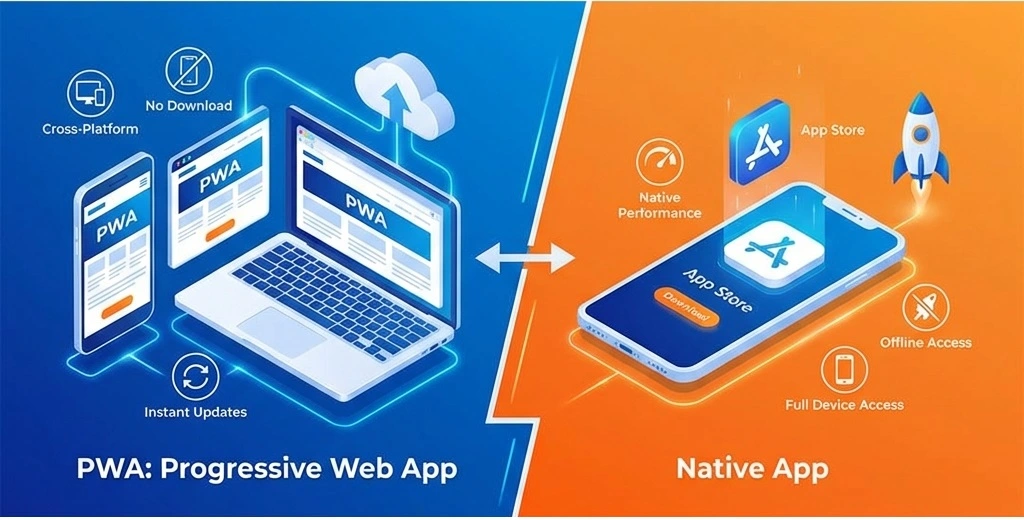
Every company planning a digital product eventually faces a multi-thousand-dollar crossroads: do you build separate Native iOS and Android applications, or do you invest in a unified Progressive Web Application (PWA)?
Direct Answer: In the PWA vs mobile app (2026) landscape, Progressive Web Apps (PWAs) are ideal for businesses seeking fast time-to-market, 50%–70% lower engineering budgets, zero app store commissions, and instant web link discoverability, while Native Apps remain necessary for graphic-intensive mobile gaming, high-frequency background GPS processing, and deep hardware biometric integrations.
At Scenic IT Solutions, we engineer both native cross-platform mobile apps and high-performance Progressive Web Apps. Here is our 2026 strategic guide to making an honest, unbiased technology investment for your business.
⚡ Key Takeaways
- PWAs run directly in mobile browsers using service workers to provide offline functionality, push notifications, and home screen installation without app store downloads.
- Building a PWA cuts initial development costs by 50% to 70% by maintaining a single, unified codebase across desktop, iOS, and Android.
- Native apps (Swift/Kotlin) remain essential for 3D mobile gaming, complex biometric hardware integrations, and heavy background Bluetooth/GPS tracking.
- PWAs completely bypass Apple and Google 15%–30% in-app purchase commissions and circumvent strict app store approval delays.
- For regulated B2B products (HIPAA, SOC2, FinTech), PWAs offer rapid zero-approval compliance patches, while Native Apps excel in hardware biometric authentication.
1. What Is the Fundamental Difference Between a PWA and a Native App?
The Direct Answer: A Native App is compiled specifically for mobile operating systems (Swift for iOS, Kotlin for Android) and downloaded through app stores, whereas a PWA is an enhanced web application built with HTML5, CSS, and JavaScript that behaves like a native app directly inside mobile browsers.
PWAs utilize modern browser APIs—including Service Workers, Web App Manifests, and IndexedDB—to cache assets locally, enabling instant loading on spotty cellular networks, offline access, and push notifications without requiring users to download a 100MB file from the App Store.
2. PWA vs Mobile App Development Costs, Maintenance & Time to Market
The Direct Answer: Developing separate native apps for iOS and Android requires two distinct engineering teams, two codebases, and separate QA cycles, easily doubling or tripling initial software costs compared to a single, unified PWA codebase.
A standard native dual-platform build typically costs $40,000 to $120,000+ and requires 4 to 6 months of engineering. In contrast, a high-performance PWA leverages your existing responsive web application architecture, cutting costs to $15,000 to $35,000 and launching in a fraction of the time.
Explore realistic software budgeting in our guide on the cost of custom web app development in 2026.
3. User Experience, Hardware Access & Offline Capabilities
The Direct Answer: Native apps offer deeper hardware integration (advanced Bluetooth LE, Apple HealthKit, ARKit, FaceID), but modern PWAs now support push notifications (including on iOS Safari), camera access, geolocation, and full offline caching.
Unless your application fundamentally depends on complex background sensors or high-frame-rate 3D graphics, a well-optimized PWA built with React or Vue.js delivers touch interactions, smooth animations, and screen transitions that are virtually indistinguishable from native code to the end user.
4. App Store Friction (30% Tax) vs. Direct Web Link Discoverability
The Direct Answer: Native apps suffer from high acquisition friction—requiring users to visit an app store, enter passwords, and wait for downloads—while paying Apple and Google a 15% to 30% cut of all digital sales. PWAs bypass app stores entirely and are 100% indexable by search engines.
With a PWA, every single screen is an organic URL that ranks in Google search results. A user clicks a search link, social ad, or email link and is immediately using your application. With a single tap on an "Add to Home Screen" prompt, the PWA installs an icon on their device home screen with zero app store friction.
5. Comprehensive Feature and Capability Comparison Matrix (Table)
The Direct Answer: This comparison matrix highlights the key operational and technical trade-offs between PWAs and Native Apps.
| Capability | Progressive Web App (PWA) | Native Mobile App (iOS / Android) |
|---|---|---|
| Codebase Count | Single unified codebase (HTML5 / JS / CSS). | Two separate codebases (Swift & Kotlin) or hybrid framework. |
| App Store Commissions | 0% (Direct payment gateway integration via Stripe). | 15% – 30% Apple / Google in-app purchase tax. |
| Distribution & Discoverability | Direct URL, indexed by Google, instant web links. | App Store / Google Play search and download required. |
| Push Notifications | Fully supported on Android & modern iOS Safari. | Native deep OS integration. |
| Storage Footprint | Minimal (typically under 5MB cache). | Large (50MB – 300MB+ device storage). |
| Average Development Cost | $15,000 – $35,000 | $40,000 – $120,000+ |
6. Choosing Between a Native App and a PWA for a Regulated B2B Product
The Direct Answer: For a regulated B2B product (such as healthcare HIPAA tools, clinical trial software, or FinTech banking compliance), a PWA is superior if you need instant zero-downtime security patch deployments without waiting for Apple/Google app store approval reviews; a Native App is required if regulatory mandates demand hardware-enclave biometric encryption (Secure Enclave FaceID) or strict MDM enterprise mobile device containerization.
As an honest software partner who has architected and deployed both native enterprise mobile apps and regulated B2B Progressive Web Apps, Scenic IT Solutions advises clients based on their exact compliance constraints:
- Instant Security & Compliance Patching: In regulated industries, waiting 3 to 7 days for Apple App Store review to approve a critical security patch is unacceptable. With a PWA, compliance and security fixes deploy server-side instantly to 100% of active enterprise users.
- MDM & Enterprise Security: If your B2B customers require distribution through Mobile Device Management (MDM) platforms like Microsoft Intune or VMware Workspace ONE, Native Apps provide deeper configuration integration.
- Biometric Security Enclave: While PWAs can use WebAuthn for browser-based TouchID/FaceID, Native Apps have direct access to iOS Secure Enclave and Android Keystore for cryptographic key generation required in high-tier FinTech.
7. Conclusion: Formulating Your 2026 Mobile Application Roadmap
The Direct Answer: For over 85% of businesses and startups, starting with a Progressive Web App is the most capital-efficient strategy, delivering mobile app convenience with zero app store gatekeepers and faster customer acquisition.
At Scenic IT Solutions, we build high-performance PWAs and custom mobile applications tailored to your business model. Check out our custom web application development services or contact our mobile engineering leads to discuss your project.
Frequently Asked Questions
Do PWAs work offline without an active internet connection?
Yes. By leveraging Service Workers and local browser storage (IndexedDB), PWAs cache essential stylesheets, scripts, and data, allowing users to browse previously viewed content and submit offline forms.
Does Apple iOS support PWA push notifications?
Yes. Since iOS 16.4, Apple Safari natively supports Web Push notifications for PWAs added to the iPhone or iPad home screen, matching Android capabilities.
We are choosing between a native app and a PWA for a regulated B2B product: Which is recommended?
If your compliance requires instant security updates and cross-platform desktop/mobile access without app store review delays, a PWA is the superior choice. If you require hardware-level biometric encryption (Secure Enclave) or strict MDM containerization, choose a Native App.
Can a PWA be published to the Google Play Store and Apple App Store?
Yes. Using tools like Trusted Web Activities (TWA) on Android and PWABuilder, businesses can package their PWA into native app store containers and list them alongside native apps.
How does a PWA improve SEO compared to a native app?
Unlike native apps locked behind app store walls, every page of a PWA is a public URL that Google crawls, indexes, and ranks in search results, driving organic web traffic.
How much does it cost to convert an existing website into a PWA?
Converting an existing responsive website into a basic PWA (adding service workers, manifest, and offline caching) typically costs $3,000 to $8,000 depending on the complexity of dynamic offline data.
📚 Related Articles & Recommended Reading

Build a High-Converting Progressive Web App Today
Cut mobile development costs in half while maximizing user engagement. Partner with Scenic IT Solutions to build a blazing-fast PWA for your brand.
Discuss Your Mobile App Strategy